
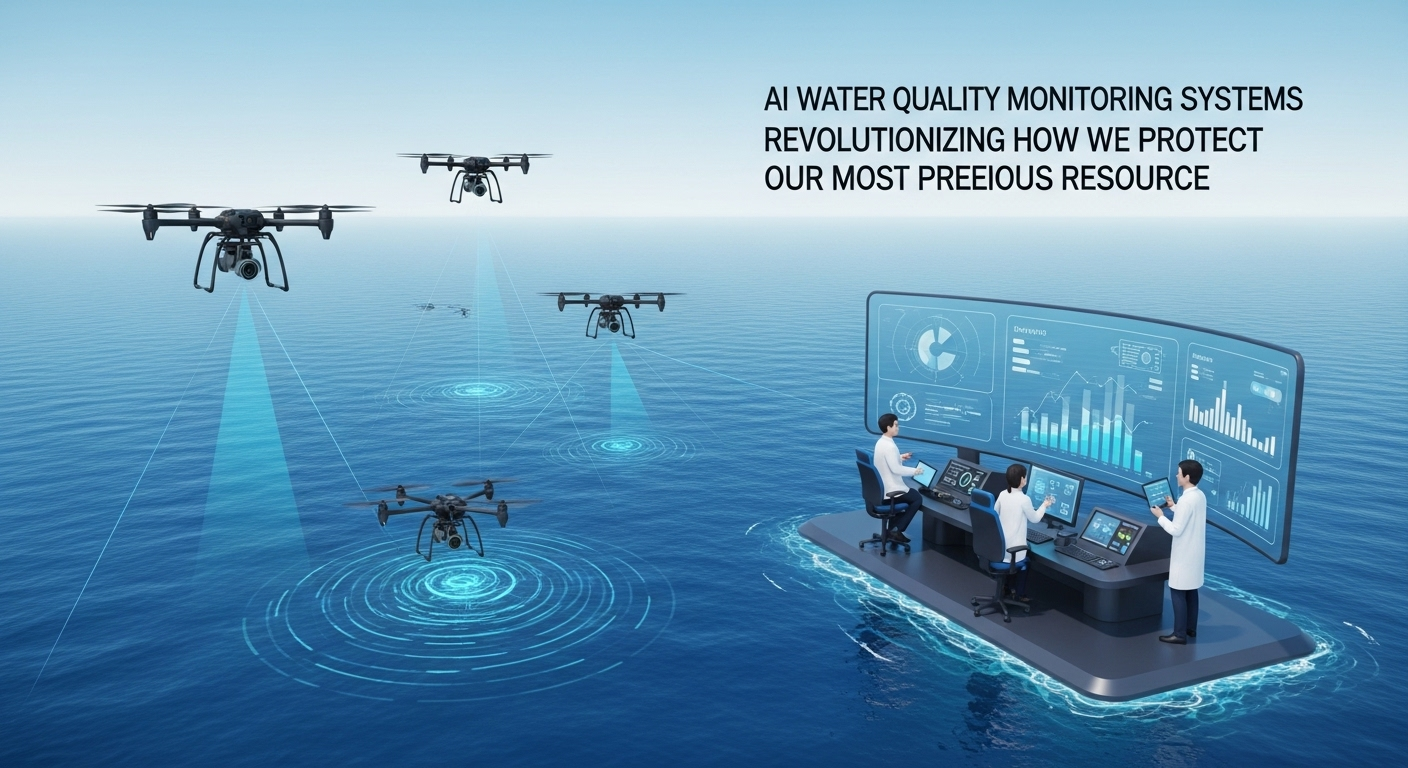
Water is one of the world’s most valuable resources, yet millions of people still lack access to clean and safe drinking water. At the same time, industrial pollution, urbanization, and climate change continue to threaten rivers, lakes, and groundwater supplies. Traditional water quality monitoring methods are often slow and reactive, making it difficult to detect contamination before it affects communities. In this guide, you’ll learn how AI powered water quality monitoring systems are transforming the way governments, industries, and utilities monitor, predict, and protect water quality in real time.
The Critical Need for Advanced Water Monitoring
Why Traditional Methods Fall Short
Traditional water quality monitoring relies heavily on manual sampling and laboratory analysis a process that can take days or even weeks to produce results. Picture this: a chemical spill occurs in a river on Monday morning, but by the time test results confirm contamination on Friday, thousands of people may have already consumed polluted water.
Key Limitations of Traditional Monitoring:
- Time Delays: Lab results can take 24-72 hours
- Limited Coverage: Spot-checking misses continuous changes
- High Costs: Labor-intensive processes strain budgets
- Human Error: Manual sampling introduces inconsistencies
- Reactive Approach: Problems detected after damage occurs
What Is an AI Water Quality Monitoring System?
AI-powered water quality monitoring systems represent a paradigm shift from reactive to proactive water management. These intelligent systems combine real-time sensors, machine learning algorithms, and predictive analytics to provide instant, accurate water quality assessments.
Core Technologies Behind AI Water Monitoring
1. Smart Sensor Networks
Modern AI water monitoring systems deploy networks of intelligent sensors that continuously measure multiple parameters:
| Parameter | Sensor Type | Significance |
|---|---|---|
| pH Levels | Ion-selective electrodes | Indicates acidity/alkalinity |
| Dissolved Oxygen | Optical sensors | Critical for aquatic life |
| Turbidity | Nephelometric sensors | Measures water clarity |
| Temperature | Thermistors | Affects chemical reactions |
| Conductivity | Conductivity cells | Indicates dissolved salts |
| Chlorine | Colorimetric sensors | Monitors disinfection levels |
| Heavy Metals | Electrochemical sensors | Detects toxic contamination |
2. Machine Learning Algorithms
AI systems employ various machine learning techniques to interpret sensor data:
Supervised Learning: Trained on historical data to recognize patterns and predict water quality trends.
Unsupervised Learning: Identifies anomalies and unusual patterns that might indicate contamination events.
Deep Learning: Neural networks process complex, multi-dimensional data to make sophisticated predictions.
Reinforcement Learning: Systems learn optimal responses to different water quality scenarios over time.
3. Edge Computing and Cloud Integration
Modern systems combine edge computing for real-time decisions with cloud processing for complex analytics:
- Edge Processing: Immediate response to critical situations
- Cloud Analytics: Deep learning and pattern recognition
- Hybrid Approach: Best of both worlds for comprehensive monitoring
Real-World Success Stories

Case Study 1: Singapore’s Smart Water Grid
Singapore, facing severe water scarcity, implemented one of the world’s most advanced AI water monitoring systems. The Public Utilities Board (PUB) deployed over 300 smart sensors across the island nation’s water network.
Results Achieved:
- 40% reduction in water quality incidents
- 60% faster response time to contamination events
- $50 million annual savings in operational costs
- 99.9% water quality compliance rate
The system successfully predicted and prevented a major contamination event in 2023 when AI algorithms detected unusual chemical patterns 48 hours before traditional methods would have identified the issue.
Case Study 2: Thames Water’s Leak Detection Revolution
Thames Water, serving 15 million customers in London, implemented AI-powered monitoring across 20,000 miles of water pipes.
Challenge: London loses 25% of its treated water through leaks equivalent to 650 million liters daily.
AI Solution: Machine learning algorithms analyze pressure patterns, flow rates, and acoustic signatures to predict pipe failures before they occur.
Impact:
- 30% reduction in water loss
- £100 million savings over five years
- 50% decrease in emergency repairs
- Improved customer satisfaction scores
Case Study 3: The Great Barrier Reef Monitoring Project
Australia’s Great Barrier Reef Marine Park Authority partnered with IBM to deploy AI-powered water quality monitoring systems across 2,300 kilometers of reef.
Technology Used:
- Underwater IoT sensors
- Satellite imagery analysis
- Machine learning for coral health prediction
- Drone-based monitoring systems
Outcomes:
- Early detection of coral bleaching events
- 25% improvement in water quality predictions
- Better-informed conservation decisions
- Enhanced tourism sustainability
Industry Applications and Use Cases
Municipal Water Systems
Cities worldwide are adopting AI water monitoring to ensure public health and regulatory compliance.
Key Applications:
- Treatment Plant Optimization: AI adjusts chemical dosing in real-time
- Distribution Network Monitoring: Continuous quality tracking from source to tap
- Leak Detection: Predictive maintenance prevents water loss
- Regulatory Compliance: Automated reporting ensures standards are met
Success Metrics:
- 95% reduction in manual testing requirements
- 70% faster contamination detection
- 40% improvement in treatment efficiency
- 80% decrease in compliance violations
Industrial Water Management
Manufacturing facilities use AI monitoring to optimize processes and ensure environmental compliance.
Common Applications:
- Cooling Water Systems: Preventing scale and corrosion
- Process Water Quality: Maintaining product standards
- Wastewater Treatment: Optimizing discharge quality
- Environmental Compliance: Meeting discharge regulations
Agricultural Water Systems
Smart farming increasingly relies on AI water monitoring for irrigation optimization and crop health.
Benefits for Agriculture:
- Precision Irrigation: Water application based on real-time soil conditions
- Nutrient Management: Optimal fertilizer application timing
- Disease Prevention: Early detection of water-borne plant diseases
- Resource Conservation: 30-50% reduction in water usage
Key Features of AI Water Quality Monitoring Systems
Predictive Analytics
AI systems don’t just monitor current conditions they predict future water quality trends.
Prediction Capabilities:
- Contamination event forecasting
- Equipment failure prediction
- Seasonal quality variations
- Long-term trend analysis
Automated Response Systems
When AI detects anomalies, systems can automatically:
- Adjust treatment parameters
- Isolate contaminated sections
- Alert emergency responders
- Initiate backup systems
Integration with Weather Data
AI systems incorporate meteorological data to enhance predictions:
- Rainfall impact on water quality
- Temperature effects on chemical reactions
- Storm surge contamination risks
- Drought impact assessments
Implementation Challenges and Solutions
Technical Challenges
| Challenge | Solution |
|---|---|
| Sensor Reliability | Redundant systems and self-calibrating sensors |
| Data Integration | Standardized protocols and APIs |
| False Alarms | Advanced algorithms and human oversight |
| Cybersecurity | Encrypted communications and secure networks |
Economic Considerations
Initial Investment Breakdown:
- Hardware and Sensors: 40-50%
- Software Development: 25-30%
- Installation and Setup: 15-20%
- Training and Support: 10-15%
Return on Investment: Most organizations see positive ROI within 18-24 months through:
- Reduced operational costs
- Prevented contamination incidents
- Improved regulatory compliance
- Enhanced operational efficiency
Regulatory Compliance
AI water monitoring systems must meet stringent regulatory requirements:
Key Regulations:
- Safe Drinking Water Act (USA)
- Water Framework Directive (EU)
- WHO Guidelines for Drinking Water Quality
- Local environmental protection standards
Future of AI in Water Quality Monitoring
Emerging Technologies
Quantum Sensors: Ultra-sensitive detection capabilities for trace contaminants
Blockchain Integration: Immutable water quality records for transparency
5G Connectivity: Faster data transmission and real-time responses
Satellite Monitoring: Large-scale water body analysis from space
Market Growth Projections
The global AI water monitoring market is experiencing explosive growth:
- 2023 Market Value: $2.1 billion
- 2030 Projected Value: $8.7 billion
- Annual Growth Rate: 22.3%
- Key Drivers: Environmental regulations, water scarcity concerns, technological advancement
Next-Generation Features
Advanced AI Capabilities Coming Soon:
- Natural language processing for report generation
- Computer vision for visual water quality assessment
- Autonomous underwater vehicles for deep-water monitoring
- AI-powered water treatment optimization
Getting Started with AI Water Monitoring
Assessment Phase
Before implementing AI water monitoring, organizations should:
- Conduct Water Quality Audit: Identify current monitoring gaps
- Define Objectives: Establish clear goals and success metrics
- Evaluate Infrastructure: Assess existing systems and connectivity
- Budget Planning: Determine investment requirements and ROI expectations
Implementation Roadmap
Phase 1: Pilot Program (3-6 months)
- Deploy sensors in critical locations
- Establish baseline data collection
- Train staff on new systems
- Validate AI model accuracy
Phase 2: Expansion (6-12 months)
- Scale sensor network
- Integrate with existing systems
- Develop custom algorithms
- Establish response protocols
Phase 3: Optimization (12+ months)
- Fine-tune AI models
- Implement predictive capabilities
- Automate response systems
- Continuous improvement processes
Key Success Factors
Critical Elements for Success:
- Executive leadership support
- Cross-functional team collaboration
- Adequate training and change management
- Robust data governance policies
- Vendor selection and partnership management
| Parameter | Sensor Type | Purpose |
|---|---|---|
| pH | Ion-selective electrode | Measures acidity or alkalinity |
| Dissolved Oxygen | Optical sensor | Indicates oxygen available for aquatic life |
| Turbidity | Nephelometric sensor | Measures water clarity |
| Temperature | Thermistor | Tracks temperature changes |
| Conductivity | Conductivity cell | Measures dissolved salts |
| Chlorine | Colorimetric sensor | Monitors disinfectant levels |
| Heavy Metals | Electrochemical sensor | Detects toxic contaminants |
The Environmental and Social Impact
Environmental Benefits
AI water monitoring systems contribute significantly to environmental protection:
- Pollution Prevention: Early detection prevents widespread contamination
- Ecosystem Protection: Monitoring helps preserve aquatic habitats
- Resource Conservation: Optimized usage reduces waste
- Climate Adaptation: Better preparation for climate-related water challenges
Social Impact
The technology’s social benefits extend far beyond environmental protection:
Public Health: Faster contamination detection protects communities
Economic Development: Reliable water quality supports industrial growth
Social Equity: Improved monitoring in underserved communities
Disaster Response: Rapid assessment capabilities during emergencies
Conclusion: The Future of Water is Smart
AI water quality monitoring systems represent more than just technological advancement they’re a fundamental shift toward intelligent, proactive water management. As we face increasing challenges from climate change, population growth, and industrial development, these systems provide the tools necessary to protect our most precious resource.
The success stories from Singapore, London, and Australia demonstrate the transformative potential of AI in water management. With continued technological advancement and increasing adoption, AI water monitoring systems will play an increasingly critical role in ensuring clean, safe water for future generations. Organizations considering implementation should start with pilot programs, focusing on specific challenges and building capabilities over time. The investment in AI water monitoring isn’t just about technology – it’s about securing a sustainable water future for our communities and our planet.
As we move forward, the integration of AI, IoT, and advanced analytics will continue to evolve, making water monitoring more intelligent, efficient, and effective. AI is becoming an important tool for improving water quality monitoring, helping utilities and industries detect contamination faster, optimize treatment processes, and make better decisions using real-time data. While AI does not replace laboratory testing or regulatory oversight, it complements traditional methods by providing continuous monitoring and predictive insights. As sensor technology and machine learning continue to improve, AI is expected to play an increasingly important role in protecting water resources and supporting sustainable water management.