Best AI Tools and Trends in 2026: The Complete Guide for Work, SEO, Coding, and Business
Table of Contents
- Key Takeaways for AI in 2026
- Why AI Tools are Exploding in 2026: Productivity vs. Experimentation
- Top AI Trends of 2026: The Age of Agents
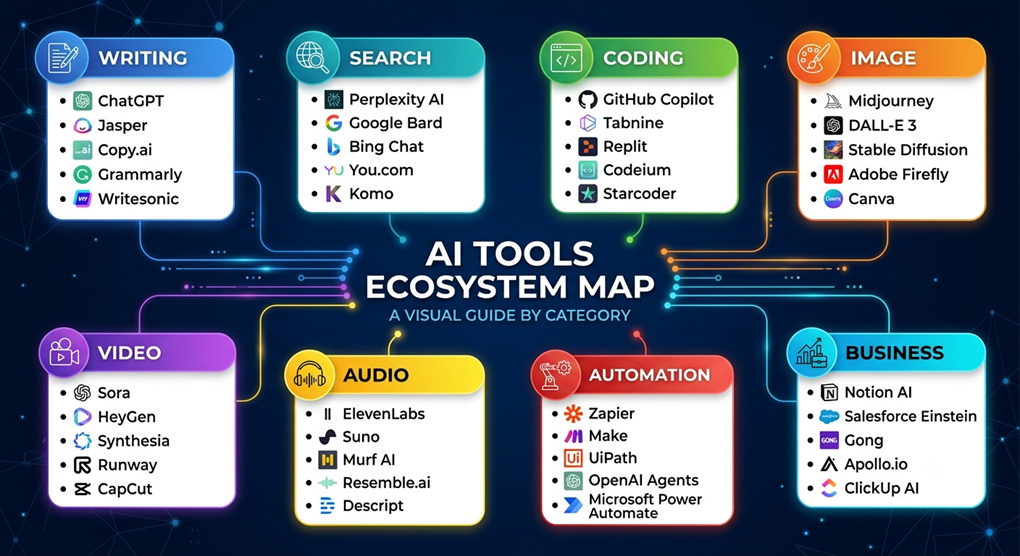
- Best AI Tools by Category: From Creative to Code
- AI Tool Comparison Table
- Strategic Use Case: Best AI for Bloggers and SEO
- Best AI Tools for Business Operations
- Best AI Tools for Creators and Digital Media
- Best AI Tools for Developers
- Strategic Decision Framework: How to Choose Your Stack
- Common AI Adoption Mistakes
- Future Predictions
- FAQs: All Your AI Questions Answered
- Final Verdict
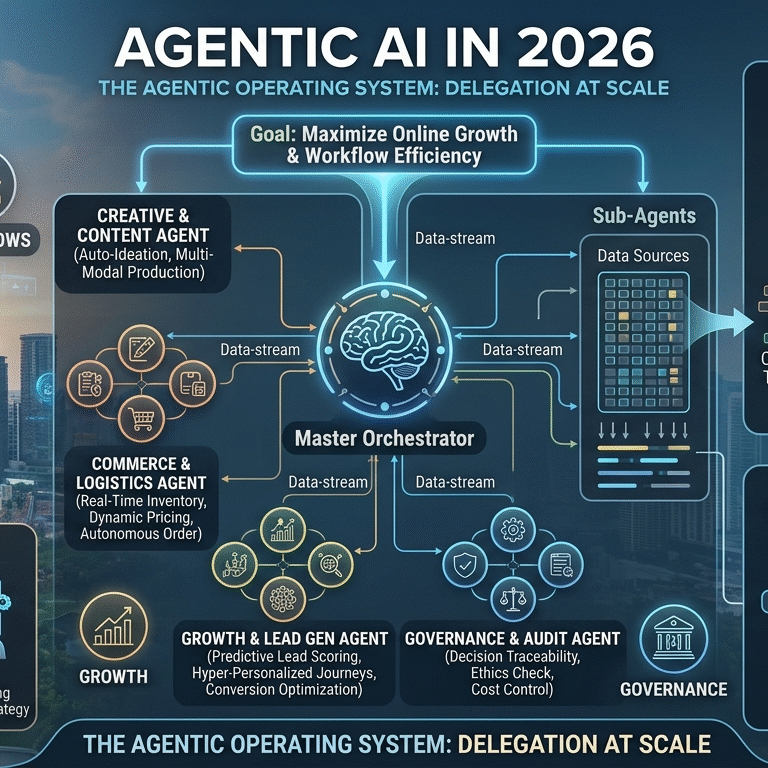
1. Agentic AI and Autonomous Agents
Agentic AI is the defining trend of 2026. A prompt no longer generates only an answer; it initializes a workflow. AI agents can break a high-level goal into a plan, execute the steps (such as researching, writing, generating an image, and updating a database), verify the output, and complete the process autonomously with defined human review points. Example: An agent that monitors compliance might read a regulation, audit company documents, draft revisions, notify the legal team, and file the update.
2. Conversational Search and Answer Engines
SEO is evolving into AIO (AI Optimization). Search is no longer about keywords and ten blue links; tools like Perplexity, ChatGPT search integrations, and Google AI Overviews provide synthetic, summarized answers derived directly from verified sources. Visibility now requires structured data and authoritative, expert-led content that AI engines trust and cite.
3. Native Multimodality
Multimodal AI is now native and mainstream across all major models. Tools possess simultaneous input/output awareness for text, image, audio, high-definition video, complex data files, diagrams, live screenshots, and codebases.
4. AI Video Generation
AI video has matured into a standard asset in marketing and production. Creators can generate short, photorealistic clips, specific product scenes, social advertisements, visual concepts, and explainer segments significantly faster and cheaper than traditional production.
5. Deep Coding Assistants
AI coding tools have moved beyond autocomplete. Tools like Cursor are AI-first code editors that understand the context of an entire codebase, suggesting refactors, writing comprehensive tests, explaining complex errors, and generating entire features, allowing developers to move from writing code to engineering systems.
6. Intelligent Workflow Automation
Automation (Zapier, n8n) is no longer rigid logic rules. With integrated AI, automation now handles dynamic tasks: categorization, sentiment analysis, intelligent summarizing, and complex decision-making within pipelines.
7. Private and On-Device AI
Privacy is a top trend for 2026. For speed and security, many enterprise and consumer applications now run smaller, powerful language models locally on consumer hardware (laptops, phones) rather than sending sensitive data to the cloud.
8. AI Governance and Compliance
For enterprise users, AI tools are now standardized with comprehensive governance protocols, security audits, transparent audit logs, and clear cost-control mechanisms essential for regulatory compliance.
9. AI for AIO (AI Optimization) and Content Operations
AI is no longer just a draft generator. It is the core of content operations, automating content planning, deep SERP analysis, semantic clustering, content refreshing, and omnichannel distribution strategies.
10. The AI Personal Productivity Stack
Users are abandoning the “one model to rule them all” philosophy. The default in 2026 is building a curated stack of specialized, interconnected AI tools, optimizing individual parts of your workflow rather than relying on a single generalist tool.
Best Foundational AI Assistants
- ChatGPT (OpenAI): The most versatile generalist tool for writing, brainstorming, workflow management, and multimodal analysis.
- Claude (Anthropic): The top choice for long-form, complex reasoning, structured writing, and large context handling, often favored for corporate data tasks.
- Gemini (Google): The deepest integration for Google Workspace users and superior handling of native multimodal tasks involving live data and files.
Search & Research Engines
- Perplexity: The unrivaled best for verifiable research, providing fast, referenced citations from diverse, live sources.
- Google AI Search Experience / Copilot: Important general consumer examples that define current search behavior.
Coding Ecosystems
- Cursor: The first truly AI-native code editor (IDE), designed to work within your actual codebase for complex analysis and feature generation.
- GitHub Copilot: The most powerful completion and suggestions engine, maximizing productivity across varied coding environments.
Image & Art Tools
- Midjourney: The highest aesthetic quality and consistent creative image generation, essential for design concepts and high-end visuals.
- Flux (and derivative apps): The leading flexible, open-weight image model, dominating varied applications for flexible image generation.
Video Production Tools
- Runway: The industry leader for multimodal scene editing, motion control, and professional, reliable video generation.
- Pika / Sora (OpenAI): Strong competitors that excel at short, creative clips and experimental visual concepts.
Audio & Voice Tools
- ElevenLabs: The absolute best for natural voice generation, professional narration, translation, and high-fidelity dubbing.
Design Platforms
- Canva AI (Magic Studio): The most user-friendly ecosystem for generating rapid social graphics, presentations, brand assets, and marketing materials with AI.
Productivity Tools
- Notion AI: Top tool for general productivity, turning extensive notes and documents into synthesis, knowledge hubs, and automated workflows.
- Microsoft Copilot: The leading integration for Microsoft 365 users, directly automating workflows within Word, Excel, and Outlook.
Automation Platforms
- Zapier: The no-code leader, leveraging AI for intelligent classification and connecting thousands of app ecosystems.
- n8n: A flexible, powerful, often self-hosted alternative favored by developers and technical teams for deep, complex workflow orchestration.
| Tool | Primary Category | Best For | Top Strength | Key Caveat |
|---|---|---|---|---|
| ChatGPT | General AI Assistant | Multimodal Productivity | Versatility & Large Ecosystem | Must rigorously fact-check |
| Claude | Advanced Reasoning | Structured Writing/Editing | Logic, Tone, & Long Context | Tool integrations vary |
| Perplexity | AI Research/Search | Verifiable deep research | Speed, Accuracy & Citations | *Must review *quality* of sources* |
| Cursor | AI Coding (IDE) | Codebase-wide Engineering | AI-First Codebase Awareness | Requires coding proficiency |
| Midjourney | AI Image Generation | Professional visual concepts | Creative Aesthetic Quality | Significant prompt skill needed |
| Runway | AI Video Generation | Professional short video asset creation | Deep multimodal scene control | Significant cost at production scale |
| Zapier | Workflow Automation | Intelligent No-Code pipelines | Massive 6,000+ App Ecosystem | Can accumulate high costs |
Autonomous Process Agents
In 2026, corporate competitive advantage is derived from internal process efficiency. Businesses leverage AI Process Agents integrated directly into ERP, CRM, and financial systems to autonomously manage logistics, predictive inventory, complex financial forecasting, and sentiment-driven customer support management.
- Process Agents: Often custom-built, proprietary systems leveraging platforms like Google Cloud’s Agentic enterprise architecture.
- SaaS-Native AI: AI Process Agents integrated directly into enterprise software (Salesforce Einstein, SAP AI).
Intelligent Corporate Communications
Beyond email, businesses use AI-integrated meeting platforms (Zoom AI, Microsoft Teams AI) that do not just summarize, but analyze sentiment, track commitments, and automatically update project management pipelines following meetings.
Synthetic Studios
Creators are moving from manual editing to directing Synthetic Studios. Text-to-Video and Motion-to-Video systems like Runway and Sora generate photorealistic B-roll, product scenes, visual effects, and complex storyboards, fundamentally restructuring production costs.
- Production: Runway, Sora, Luma AI (text/video-to-3D).
- Voiceover & Translation: ElevenLabs dominates professional narration and natural dubbing/translation pipelines.
Autonomous Systems Engineering
The paradigm shift for developers in 2026 is moving from coding to systems engineering. AI coding assistants are no longer external tools; they are integrated into AI-native environments that possess deep, structural understanding of massive codebases. They find bugs, analyze security vulnerabilities, recommend refactors, write tests for existing logic, and can generate entire functional features.
- IDE (Environment): Cursor is the defining tool.
- Copilots: GitHub Copilot, Tabnine (for enterprise security/hosting).
The smartest users in 2026 do not adopt every tool. They follow a defined decision framework to maximize ROI and avoid tool overload:
Integrated “OS Agents”
We will see OS Agents integrated directly into personal and business operating systems (Apple Intelligence, Microsoft Copilot on Windows). These agents will connect foundational models directly to your local file systems, application usage, and operational history, allowing personalized, secure, on-device automation.
Vertical Specialization Overdose
General-purpose LLMs are saturating. The market of late 2026 will be defined by highly specialized Vertical AI Tools trained on massive, proprietary datasets for specific legal, medical, engineering, and scientific fields.
Crucial Best Practices
- Draft-Only Directive: Treat all AI outputs as high-quality drafts, not definitive truth. Your expertise, verification, and unique insight provide the final value.
- Verify Everything (Zero-Trust): Build multi-step verification workflows. Never trust a single AI-generated data point or citation without secondary verification.
- Originality still matters: In an AI-saturated market, your human experience, authentic voice, unique case studies, and lived insights are more valuable than ever. This content cannot be generated.
- Ecosystem Integration over Isolation: Prioritize tools that seamlessly connect via API to your automation platforms (Zapier/n8n) and your database ecosystems.
Frequently Asked Questions (FAQs)
Q: Which are the best AI tools in 2026?
A: There is no single “best” tool. Success requires curating a dynamic stack including foundational models (ChatGPT, Claude, Gemini), deep research engines (Perplexity), special tools (like Cursor for code, Midjourney for images, Runway for video, Canva for design, Notion for productivity, ElevenLabs for audio), and integration platforms (Zapier / n8n).
Q: What is the single biggest AI trend in 2026?
A: The defining trend is Agentic AI proactive AI systems (AI Agents) that move beyond synthesis to autonomously planning, executing, and validating complex multi-step workflows.
Q: How has AI changed SEO (Search Engine Optimization) in 2026?
A: SEO traditional has evolved into AIO (AI Optimization). Search results are conversational answer synthesis (like Perplexity and Google Overviews), derived from trusted sources. Visibility now requires structured data and expert-verified, authoritative, schema-compliant content.