All posts by hannanmentor@gmail.com

15 Ways AI for Data Analysis is Changing Game: A Complete Guide

Introduction: Understanding the Data Revolution

Picture this: you’re standing in front of a massive library with millions of books, but they’re all written in different languages, scattered randomly on floors, and some pages are missing or damaged. Your job? Find the specific information that will help your business make a million-dollar decision by tomorrow morning. Sounds impossible, right?

This scenario perfectly captures what data analysis looked like just a decade ago. Today, Artificial Intelligence has transformed this chaotic library into an intelligent assistant that not only organizes everything instantly but also predicts what you’ll need to know next.

The Data Explosion: By the Numbers

Let’s put the current data landscape into perspective:

Data Growth StatisticsScaleReal-World Comparison
Daily data creation2.5 quintillion bytes250,000 Libraries of Congress
Internet users worldwide5.16 billion people64.4% of global population
Daily Google searches8.5 billion99,000 searches per second
Daily emails sent347 billion4 million per second
IoT devices generating data75 billion by 202510 devices per person globally

What is AI in data analysis? Think of AI in data analysis as giving your data a brain. Instead of simply storing numbers and facts, AI systems can understand patterns, learn from experience, and make predictions about future trends. It’s like having a brilliant analyst who never sleeps, never makes calculation errors, and can process information thousands of times faster than any human.

But here’s what makes it truly revolutionary: AI doesn’t just process data faster—it finds connections that humans would never think to look for. It can analyze customer behavior patterns across millions of transactions, predict equipment failures weeks before they happen, and identify fraud attempts in milliseconds.

Why AI is Essential Now: The Perfect Storm

Several factors have converged to make AI in data analysis not just useful, but absolutely critical:

1. The Volume Challenge

  • 90% of all data was created in just the last two years
  • Traditional analysis methods break down at scale
  • Human analysts can’t keep pace with data generation rates

2. The Speed Imperative

  • Business cycles are accelerating rapidly
  • Competitive advantages are increasingly temporary
  • Real-time decision-making has become the norm
  • Example: Stock prices can change thousands of times per second based on algorithmic trading

3. The Complexity Factor

  • Data comes from dozens of sources simultaneously
  • Relationships between variables are increasingly non-linear
  • Traditional statistical methods miss subtle patterns
  • Case Study: Netflix’s recommendation engine analyzes over 1,300 factors to suggest what you’ll watch next

4. The Democratization Demand

  • Business users want direct access to insights
  • IT departments can’t handle all analysis requests
  • Self-service analytics has become an expectation
  • Stat: 85% of business decisions are now made by non-technical managers who need AI-simplified insights

Real-World Impact: AI Data Analysis Success Stories

Amazon’s Revenue Boost: Amazon attributes 35% of its revenue to its AI-powered recommendation engine. That’s approximately $137 billion in annual revenue directly linked to AI data analysis.

Walmart’s Inventory Optimization: Using AI to analyze sales patterns, weather data, and local events, Walmart reduced inventory costs by $2 billion while improving product availability by 16%.

Netflix’s Content Strategy: AI analysis of viewing patterns helped Netflix save $1 billion annually by producing original content that audiences actually want to watch, rather than licensing expensive shows that might flop.

The Evolution of Data Analysis: From Manual to Magical

The Old Way

Let’s take a journey back to understand how far we’ve come. Traditional data analysis was like being a detective with only a magnifying glass and notepad. Data analysts would spend 80% of their time just preparing data—cleaning spreadsheets, removing duplicates, filling in missing values, and formatting everything correctly.

The Traditional Workflow: A Day in the Life (2015)

Monday Morning: The Analysis Request
9:00 AM - Marketing manager requests campaign performance analysis
9:15 AM - Data analyst begins gathering data from 5 different systems
11:30 AM - Discovers data formats don't match across systems

Tuesday-Wednesday: The Data Wrestling
- Export data from CRM system (2 hours)
- Export data from email platform (1.5 hours) 
- Export data from web analytics (1 hour)
- Clean and standardize formats (8 hours)
- Remove duplicates and fix errors (4 hours)
- Create pivot tables and basic charts (3 hours)

Thursday: The Analysis
- Identify trends and patterns manually (4 hours)
- Calculate basic statistics (2 hours)
- Create PowerPoint presentation (3 hours)

Friday: The Delivery
- Present findings to stakeholders
- Answer follow-up questions that require additional analysis
- Promise to have answers "by next week"

Total Time: 32+ hours for basic analysis

The Fundamental Problems:

ChallengeImpactExample
Manual Data Cleaning80% of analyst time wastedAnalyst spends 6 hours fixing date formats
Human Error15-20% error rate in calculations$50K budget miscalculation due to formula error
Limited ScaleCan only analyze small datasetsMissing patterns in millions of customer records
Delayed InsightsDecisions based on outdated informationProduct launch based on 3-month-old market data
Siloed AnalysisEach department works independentlyMarketing and sales use different customer definitions

Enter AI: The Game Changer

Artificial Intelligence didn’t just improve data analysis—it completely reimagined what was possible. Think of the difference between a horse-drawn carriage and a rocket ship. Both can transport you, but one opens up entirely new destinations.

The AI-Powered Workflow: Same Analysis in 2024

Monday Morning: The Analysis Request
9:00 AM - Marketing manager asks AI assistant: "Show me last quarter's campaign performance"
9:01 AM - AI instantly connects to all data sources
9:02 AM - Automated data cleaning and integration complete
9:03 AM - Interactive dashboard generated with insights
9:05 AM - Follow-up questions answered in real-time
9:10 AM - Predictive recommendations for next quarter provided

Total Time: 10 minutes for comprehensive analysis

AI’s Revolutionary Capabilities:

1. Machine Learning Evolution

  • 2010: Simple rule-based systems
  • 2015: Basic pattern recognition
  • 2020: Deep learning and neural networks
  • 2024: Self-improving algorithms that get smarter over time

2. Pattern Recognition at Scale

Human Analyst Capacity:
- Can review ~1,000 data points per hour
- Identifies obvious patterns and correlations
- Limited to 2-3 variable relationships
- Prone to confirmation bias

AI System Capacity:
- Processes millions of data points per second
- Discovers hidden patterns across hundreds of variables
- Identifies non-linear relationships
- Objective pattern detection without bias

3. Predictive Power Comparison

Prediction TypeTraditional MethodAI MethodAccuracy Improvement
Sales ForecastingHistorical averagesMachine learning models35-60% more accurate
Customer ChurnBasic demographic rulesBehavioral pattern analysis3x better prediction
Fraud DetectionTransaction rulesReal-time anomaly detection10x fewer false positives
Equipment MaintenanceScheduled intervalsPredictive maintenance40% reduction in downtime

How AI is Revolutionizing Data Analysis

Speed and Accuracy:

Imagine having to count every grain of sand on a beach versus having a machine that can instantly tell you the exact number while also categorizing each grain by size, color, and mineral composition. That’s the difference AI has made in terms of speed and accuracy.

Speed Revolution by the Numbers:

Analysis TaskTraditional TimeAI-Powered TimeSpeed Improvement
Customer segmentation (1M records)2-3 weeks15 minutes2,000x faster
Sales forecast generation5-7 days30 seconds14,000x faster
Fraud detection screening24-48 hoursReal-timeInstant
Market trend analysis1-2 weeks5 minutes4,000x faster
A/B test statistical analysis2-3 days10 minutes400x faster

Accuracy Improvements: AI systems can process terabytes of data—equivalent to approximately 1,000 copies of the Encyclopedia Britannica—in mere minutes. More importantly, they do this without the fatigue, distraction, or cognitive biases that affect human analysts.

Human vs. AI Error Rates:

Data Processing Accuracy:
├── Human Analyst: 85-92% accuracy
│   ├── Fatigue factor after 4 hours: -15% accuracy
│   ├── Repetitive task errors: 5-8% error rate
│   └── Cognitive bias impact: 10-15% skewed results
│
└── AI System: 99.5-99.9% accuracy
    ├── Consistent performance: No fatigue degradation
    ├── Pattern recognition: Catches subtle errors humans miss
    └── Objective analysis: No confirmation bias

Real-World Accuracy Impact:

  • JPMorgan Chase: AI contract analysis system processes in seconds what took lawyers 360,000 hours annually, with 95% fewer errors
  • Google: AI-powered fraud detection has 99.9% accuracy compared to 85% for traditional rule-based systems
  • Mayo Clinic: AI diagnostic imaging shows 94% accuracy vs. 86% for human radiologists in certain cancer screenings

Handling Big Data in Real-Time

Consider the difference between watching a live sports game and reading about it in tomorrow’s newspaper. Real-time data analysis gives businesses the equivalent of live coverage for their operations, customers, and markets.

The Scale of Real-Time Processing:

Modern AI systems can simultaneously monitor thousands of data streams. Here’s what “real-time” actually means in different contexts:

IndustryData VolumeProcessing SpeedReal-World Impact
Financial Trading1M+ transactions/second<1 millisecond response$50B daily trading volume
E-commerce100K+ user actions/minute<100 millisecondsInstant price optimization
Social Media500M+ posts/day<1 second trend detectionViral content identification
IoT Manufacturing1M+ sensor readings/minute<5 seconds alert responseEquipment failure prevention
Digital Advertising10M+ bid requests/second<10 millisecondsPersonalized ad targeting

Real-Time Processing Architecture:

Traditional Batch Processing (Old Way):
Data Collection → Storage → Processing → Analysis → Reporting
Timeline: Hours to Days

AI Real-Time Processing (New Way):
Data Stream → Instant Processing → Live Analysis → Immediate Action
Timeline: Milliseconds to Seconds

Case Study – Uber’s Real-Time Pricing: Uber’s AI system processes:

  • Real-time location data from millions of users
  • Historical demand patterns by location and time
  • Current supply of available drivers
  • External factors (weather, events, traffic)
  • Competitor pricing information

Result: Dynamic pricing updates every few minutes across 10,000+ cities, optimizing both driver earnings and passenger wait times while maximizing platform efficiency.

The Compound Effect of Speed + Accuracy: When you combine AI’s speed with its accuracy, you get more than just faster results—you enable entirely new business models:

New Capabilities Enabled:

  1. Micro-Moment Marketing: Respond to customer intent within seconds of expression
  2. Predictive Maintenance: Fix equipment before it breaks, not after
  3. Dynamic Optimization: Continuously adjust strategies based on real-time performance
  4. Instant Personalization: Customize experiences for each individual interaction
  5. Automated Decision-Making: Systems that respond faster than human reaction time

Performance Multiplication Example:

Traditional Analysis Cycle:
Collect Data (1 day) → Process (2 days) → Analyze (1 day) → Decide (1 day) → Act (1 day)
Total: 6 days per cycle
Annual cycles: ~60

AI-Enhanced Cycle:
Collect → Process → Analyze → Decide → Act (all in real-time)
Total: Minutes per cycle  
Annual cycles: Thousands

Result: 100x more learning opportunities and optimization iterations

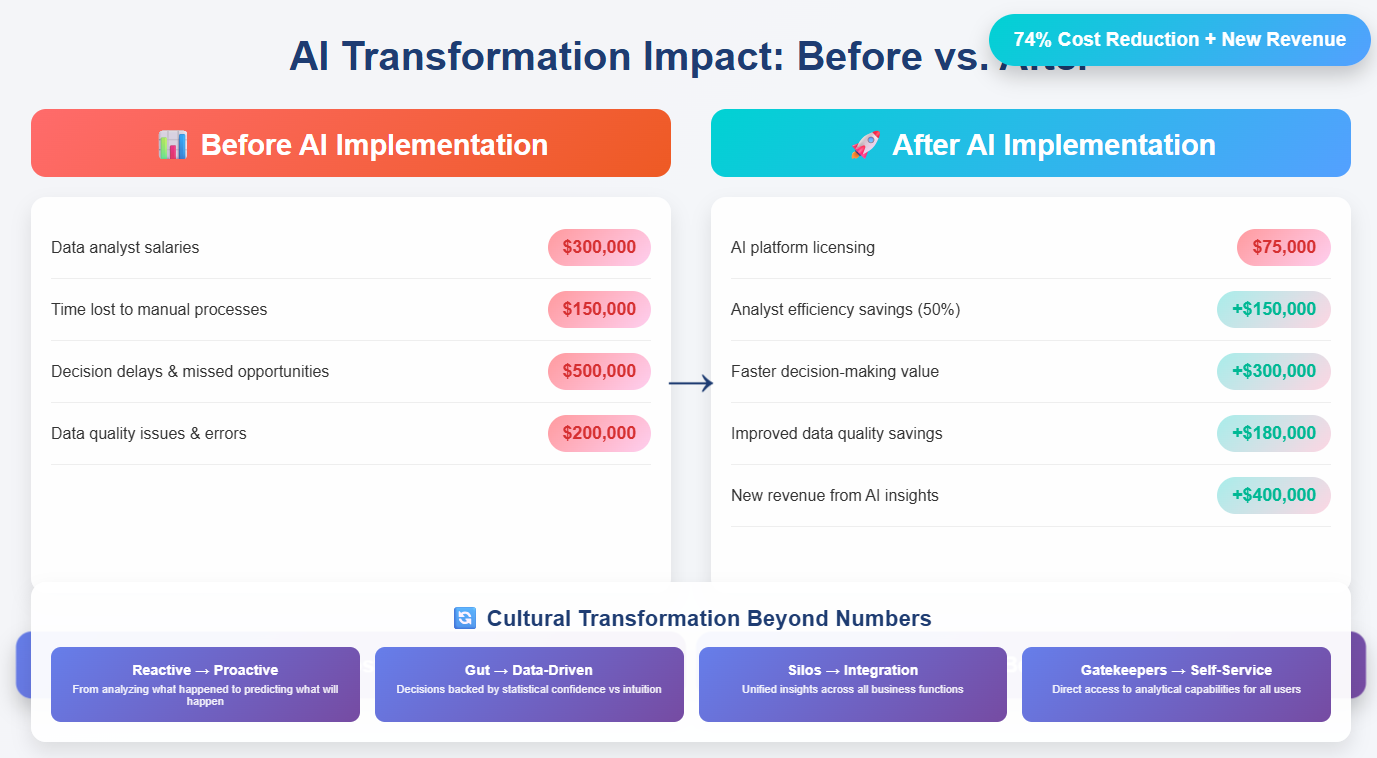
This speed and accuracy combination creates a compounding effect. Faster analysis means more iterations and refinements. Better accuracy means more reliable insights for decision-making. Together, they enable organizations to move from monthly reports to real-time intelligence, from reactive problem-solving to predictive optimization.

15 Ways AI for Data Analysis is Changing the Game

1. Predictive Analytics

Predictive analytics represents perhaps the most profound shift AI has brought to data analysis. Instead of simply describing what happened (descriptive analytics) or explaining why it happened (diagnostic analytics), predictive analytics answers the crucial question: “What will happen next?”

Think of predictive analytics as a highly sophisticated weather forecast for your business. Just as meteorologists use atmospheric data, historical patterns, and complex models to predict tomorrow’s weather, AI systems analyze your business data to forecast future trends, customer behavior, and market conditions.

The power lies in the sophistication of modern algorithms. Machine learning models can identify patterns too complex for human analysts to detect, incorporating hundreds or thousands of variables simultaneously. For example, an e-commerce company might use predictive analytics to forecast demand by analyzing historical sales, seasonal trends, economic indicators, social media sentiment, weather patterns, and competitor activities all at once.

This capability transforms strategic planning from educated guessing to data-driven forecasting. Companies can anticipate customer churn before it happens, predict which products will be popular next season, or identify which marketing campaigns will generate the highest return on investment.

2. Real-Time Insights: Instant Decision Making

Real-time insights represent the difference between driving with a GPS that updates live traffic conditions versus using a paper map from last year. In today’s fast-paced business environment, the ability to access current, accurate information instantly can mean the difference between seizing an opportunity and missing it entirely.

AI-powered real-time analytics systems continuously monitor data streams and update insights as new information arrives. This isn’t just about speed—it’s about relevance. A retail company can adjust pricing based on current demand, a social media manager can respond to trending topics as they emerge, and a financial institution can detect fraudulent transactions within milliseconds of them occurring.

The technical achievement behind real-time insights is remarkable. AI systems must process, analyze, and present findings faster than humans can consume the results, all while maintaining accuracy and filtering out noise from the constant data flow.

3. Automated Data Cleaning: Goodbye Spreadsheets

If traditional data analysis was like cooking, data cleaning was washing the dishes—necessary but tedious work that consumed most of your time. AI has essentially given us a dishwasher for data, handling the cleaning automatically while we focus on the creative aspects of analysis.

Automated data cleaning addresses several common problems that plague datasets. Missing values are intelligently filled using statistical methods or machine learning predictions rather than simple averages. Duplicate records are identified and merged, even when they’re not exact matches—AI can recognize that “John Smith” and “J. Smith” with the same address likely refer to the same person. Outliers are detected and either corrected or flagged for review, preventing skewed analysis results.

Perhaps most importantly, AI can standardize data formats across different sources. When integrating customer data from your website, mobile app, and in-store purchases, AI can harmonize different date formats, address styles, and naming conventions into a consistent, analyzable dataset.

This automation doesn’t just save time—it improves data quality. Human data cleaners get tired, distracted, or develop patterns that miss certain types of errors. AI systems apply consistent rules and can learn to recognize new types of data quality issues over time.

4. Enhanced Data Visualization: AI-Generated Dashboards

Traditional data visualization was like painting by numbers—you decided what charts to create and how to format them based on predetermined ideas about what might be important. AI-enhanced visualization is more like having an artistic collaborator who suggests compositions, highlights interesting details, and even creates entirely new ways of seeing your data.

AI-powered visualization tools can automatically identify the most effective chart types for different kinds of data relationships. They can highlight anomalies, trends, and patterns that might not be obvious in standard presentations. More sophisticated systems can generate narrative explanations alongside visuals, essentially creating self-explaining dashboards.

The real breakthrough comes from AI’s ability to adapt visualizations based on the audience and context. A dashboard for executives might emphasize high-level trends and key performance indicators, while the same data presented to operational managers would focus on actionable details and specific metrics they can influence.

Dynamic visualization capabilities mean dashboards that evolve as data changes. Colors, sizes, and layouts adjust automatically to highlight what’s most important at any given moment, ensuring critical insights don’t get lost in static displays.

5. NLP: Understand Human Language in Data

Natural Language Processing bridges the gap between how computers process information and how humans naturally communicate. Instead of learning query languages or navigating complex interfaces, you can simply ask questions in plain English and receive meaningful answers.

This capability transforms data analysis from a technical skill to a conversational interaction. Marketing managers can ask, “Which social media campaigns generated the most engagement last month?” Finance teams can inquire, “Show me all transactions over $10,000 from new customers this quarter.” HR departments can request, “Identify employees at high risk for turnover based on recent survey responses.”

The sophistication of modern NLP goes beyond simple keyword matching. AI systems understand context, synonyms, and even implied questions. They can handle follow-up queries that reference previous results and can clarify ambiguous requests by asking for more specific parameters.

This democratization of data analysis means insights are no longer bottlenecked through technical teams. Domain experts who understand the business context can directly explore data and generate insights without waiting for SQL queries or custom reports.

6. Fraud Detection: Keeping Your Data (and Money) Safe

AI-powered fraud detection represents one of the clearest examples of machine learning’s superiority over traditional rule-based systems. While conventional fraud detection relies on predetermined patterns and thresholds, AI systems learn to recognize fraudulent behavior by analyzing millions of legitimate and suspicious transactions.

The sophistication of AI fraud detection lies in its ability to identify subtle patterns that would be invisible to human analysts. It might notice that fraudulent transactions tend to occur at specific times of day, follow certain geographic patterns, or involve particular combinations of merchant categories. More importantly, it adapts as fraudsters change their tactics, continuously learning from new examples of both legitimate and fraudulent activity.

Real-time scoring means every transaction receives a risk assessment within milliseconds. High-risk transactions can be flagged for additional verification, while clearly legitimate transactions proceed without delay. This balance between security and user experience is crucial—too many false positives frustrate customers, while missed fraud attempts directly impact the bottom line.

7. Recommendation Engines: Personalization at Its Best

Recommendation engines represent AI’s ability to understand individual preferences and predict what each person might want next. This isn’t just about suggesting products—it’s about creating personalized experiences that feel almost telepathic in their accuracy.

The sophistication of modern recommendation systems goes far beyond “customers who bought this also bought that.” AI analyzes dozens of factors: browsing history, purchase patterns, seasonal preferences, demographic information, social connections, and even the time spent considering different options. It identifies similar users and learns from their preferences while also recognizing what makes each individual unique.

Successful recommendation engines create a positive feedback loop. As users interact with recommendations—clicking, purchasing, or dismissing suggestions—the system learns and improves. This continuous learning means the recommendations get more accurate over time, increasing engagement and satisfaction.

The applications extend beyond e-commerce. Streaming services recommend content, job sites suggest career opportunities, dating apps match compatible partners, and news platforms curate personalized feeds. In each case, AI transforms vast catalogs of options into manageable, relevant selections.

8. Customer Behavior Analysis: Know Your Audience Inside Out

Understanding customer behavior has evolved from simple demographics and purchase history to comprehensive behavioral analytics that reveal the “why” behind customer actions. AI can analyze customer journeys across multiple touchpoints, identifying patterns that predict satisfaction, loyalty, and lifetime value.

Modern customer behavior analysis examines micro-interactions: how long someone spends reading product descriptions, which features they explore in a mobile app, how they respond to different types of marketing messages, and even how their behavior changes based on external factors like weather or news events.

This deep understanding enables hyper-personalized experiences. Instead of treating all customers the same way, businesses can adapt their approach based on individual behavioral profiles. Some customers prefer detailed information before making decisions, while others want streamlined, quick interactions. Some respond better to emotional appeals, while others prefer logical, fact-based presentations.

The predictive aspect is particularly powerful. By identifying early warning signs of customer dissatisfaction or churn risk, businesses can proactively address issues before losing valuable customers. This shift from reactive customer service to predictive relationship management represents a fundamental change in how businesses think about customer relationships.

9. Anomaly Detection: Spotting What Doesn’t Belong

Anomaly detection is like having a security guard who never sleeps and notices even the smallest details that seem out of place. In data analysis, anomalies might indicate opportunities, problems, or fraud, but they’re often buried within normal fluctuations that make them difficult to spot manually.

AI-powered anomaly detection systems establish baselines of normal behavior by analyzing historical data patterns. They learn what constitutes typical variations versus genuinely unusual events. This baseline understanding allows them to identify anomalies that might seem normal in isolation but are unusual within the broader context.

The applications are diverse and critical. In manufacturing, anomaly detection can identify equipment that’s beginning to fail before it breaks down, preventing costly production interruptions. In cybersecurity, it can spot unusual network traffic patterns that might indicate a breach. In finance, it can flag transactions that fall outside normal patterns for additional review.

What makes AI-based anomaly detection particularly powerful is its ability to adapt as normal patterns change. Seasonal businesses, growing companies, and evolving markets all create shifting baselines that would confuse static rule-based systems but are automatically accommodated by learning algorithms.

10. Forecasting and Trend Analysis: Staying Ahead of the Curve

Forecasting with AI goes beyond simple linear projections to incorporate complex, interconnected factors that influence future outcomes. Traditional forecasting might project next month’s sales based on historical growth rates, while AI-powered forecasting considers seasonality, economic indicators, competitor actions, social media sentiment, and dozens of other variables.

The sophistication of modern forecasting lies in its ability to handle uncertainty and multiple scenarios. Instead of providing a single prediction, AI systems can generate probability ranges and confidence intervals. They can model different scenarios—what happens if the economy enters a recession, if a new competitor enters the market, or if consumer preferences shift toward sustainability.

Time series analysis with AI can identify patterns that aren’t immediately obvious: cyclical trends that repeat every few years, correlations between seemingly unrelated factors, or leading indicators that predict changes months in advance. This capability enables strategic planning that accounts for both predictable patterns and potential disruptions.

Real-World Example: Netflix uses AI forecasting to predict which shows will be popular in different regions months before they’re released. By analyzing viewing patterns, seasonal trends, cultural preferences, and even social media conversations, they can invest in content that’s likely to succeed and avoid expensive flops.

11. Image and Video Data Analysis: Beyond Just Text and Numbers

The ability to analyze visual data represents one of AI’s most impressive capabilities. While humans excel at interpreting images intuitively, AI systems can process thousands of images per second while identifying patterns and details that might escape human observation.

Computer vision technology enables machines to “see” and understand visual content at scale. This isn’t just about recognizing objects—modern AI can analyze emotions in facial expressions, assess product quality from manufacturing photos, monitor safety compliance through security cameras, and even diagnose medical conditions from X-rays or MRI scans.

Industry Applications:

IndustryUse CaseImpact
RetailVisual product search and recommendation35% increase in conversion rates
ManufacturingQuality control and defect detection90% reduction in defective products
HealthcareMedical imaging analysis20% faster diagnosis accuracy
AgricultureCrop monitoring and yield prediction15% increase in harvest yields
SecurityReal-time threat detection60% faster incident response

Case Study – Starbucks: The coffee giant uses AI-powered image analysis to ensure consistency across thousands of locations. Cameras analyze how baristas prepare drinks, checking for proper foam consistency, ingredient proportions, and presentation standards. This technology helped reduce quality complaints by 40% while maintaining the consistent experience customers expect.

12. Decision Support Systems: Making Smarter Business Choices

AI-powered decision support systems act as intelligent advisors that synthesize complex information and present actionable recommendations. Unlike simple reporting tools that show what happened, these systems analyze multiple scenarios, weigh various factors, and suggest optimal courses of action.

These systems excel at handling decisions with multiple variables and competing priorities. For example, a supply chain decision might need to balance cost, delivery speed, quality, and risk factors. AI can evaluate thousands of possible combinations and recommend the optimal approach based on your specific priorities and constraints.

Decision Framework Comparison:

Traditional Decision Making:
Step 1: Gather data manually (2-3 days)
Step 2: Create analysis spreadsheets (1-2 days)
Step 3: Present findings to stakeholders (1 day)
Step 4: Debate and decide (2-3 days)
Total Time: 6-9 days

AI-Enhanced Decision Making:
Step 1: AI processes all available data (minutes)
Step 2: Multiple scenarios generated automatically (minutes)
Step 3: Recommendations with confidence levels presented (real-time)
Step 4: Informed decision made quickly (same day)
Total Time: Hours instead of days

Real Example – UPS: The logistics company uses AI decision support for route optimization. The system considers package delivery priorities, traffic patterns, weather conditions, driver schedules, and fuel costs to recommend optimal routes. This AI-driven approach saves UPS over 10 million gallons of fuel annually and reduces delivery times by an average of 30 minutes per route.

13. Chatbots for Data Queries: Ask Questions, Get Data Answers

Conversational AI has transformed how people interact with data systems. Instead of learning complex query languages or navigating multiple dashboards, users can simply ask questions in natural language and receive immediate, accurate responses.

Modern data chatbots understand context, handle follow-up questions, and can even proactively suggest related insights. They remember previous conversations and can build upon earlier queries to create deeper analytical discussions.

Interactive Query Examples:

User: “How did our mobile app downloads perform last quarter?” AI: “Q3 mobile downloads: 145,000 (↑23% vs Q2). iOS: 87,000, Android: 58,000. Peak download day was Sept 15th with 2,340 downloads.”

User: “What caused the spike on September 15th?” AI: “The spike correlates with your ‘Back to School’ marketing campaign launch and a 4.8-star app store feature. Social media mentions increased 340% that day.”

User: “Show me similar successful campaign patterns” AI: “I found 3 similar patterns: holiday-themed campaigns with app store features generate 2.1x normal downloads. Would you like me to analyze the common elements?”

14. Cybersecurity: Guarding Sensitive Data

AI has revolutionized cybersecurity by enabling systems that learn and adapt to new threats in real-time. Traditional security systems rely on known threat signatures, but AI can identify suspicious behavior patterns even when dealing with completely new types of attacks.

Machine learning algorithms analyze network traffic, user behavior, and system activities to establish baseline patterns of normal operation. When something deviates from these patterns—even slightly—the system can flag it for investigation or automatically implement protective measures.

Threat Detection Comparison:

Traditional SecurityAI-Enhanced Security
Reactive – responds after threats identifiedProactive – predicts and prevents threats
Rule-based detectionPattern-based learning
Manual updates requiredSelf-updating algorithms
High false positive ratesContextual threat assessment
Limited to known threatsDetects unknown/zero-day attacks

Success Story – Darktrace: This AI cybersecurity company’s technology detected a sophisticated attack at a manufacturing company where hackers had been lurking undetected for months. The AI noticed subtle anomalies in data transfer patterns that human analysts had missed, preventing the theft of valuable intellectual property worth millions of dollars.

15. Democratization of Data Analysis: Empowering Non-Tech Users

Perhaps the most transformative aspect of AI in data analysis is how it’s making sophisticated analytics accessible to everyone, not just data scientists and technical specialists. This democratization is breaking down silos and enabling domain experts to directly explore and analyze their data.

Before AI Democratization:

  • Marketing manager has question about campaign performance
  • Submits request to data team
  • Waits 3-5 days for custom report
  • Receives static analysis
  • Asks follow-up questions
  • Waits another 2-3 days
  • Total time: 1-2 weeks

After AI Democratization:

  • Marketing manager asks AI system directly
  • Receives immediate interactive analysis
  • Explores data with follow-up questions
  • Discovers insights in real-time
  • Makes data-driven decisions immediately
  • Total time: Minutes

Tools Making This Possible:

Tool CategoryExample ToolsKey Features
Self-Service BITableau, Power BIDrag-and-drop analytics
Conversational AnalyticsThoughtSpot, SisenseNatural language queries
No-Code MLDataRobot, H2O.aiAutomated model building
Collaborative PlatformsHex, ObservableShared analysis workflows

Industry-Specific Applications and Case Studies

Healthcare: Saving Lives Through Data

Case Study – Mount Sinai Health System: This New York-based health system uses AI to analyze patient data and predict which patients are at risk of sepsis—a life-threatening condition that kills 250,000 Americans annually. Their AI system, called TREWS (Targeted Real-time Early Warning System), analyzes patient vital signs, lab results, and medical history every 15 minutes.

Results:

  • 18% reduction in sepsis-related deaths
  • 1.5 days shorter average hospital stays
  • $1.5 million annual savings per hospital
  • 31% faster treatment initiation

Retail: Understanding Customer Desires

Case Study – Sephora: The beauty retailer uses AI across multiple touchpoints to create personalized shopping experiences. Their AI analyzes customer purchase history, skin tone, facial features from uploaded photos, and even seasonal preferences to recommend products.

AI Applications:

  • Virtual Artist app uses AR and AI for virtual makeup try-ons
  • Color IQ technology matches foundation shades using spectral analysis
  • Predictive analytics forecast inventory needs by location
  • Chatbot handles 80% of customer service inquiries

Results:

  • 45% increase in online conversion rates
  • 60% improvement in customer satisfaction scores
  • 25% reduction in product returns
  • $50 million increase in annual revenue attributed to AI initiatives

Manufacturing: Predictive Maintenance Revolution

Case Study – Rolls-Royce: The aerospace manufacturer uses AI to monitor jet engines in real-time, predicting maintenance needs before problems occur. Their “Engine Health Management” system analyzes data from thousands of sensors on each engine.

Data Points Analyzed:

  • Temperature variations across engine components
  • Vibration patterns during different flight phases
  • Fuel consumption efficiency metrics
  • Oil pressure and quality indicators
  • Historical maintenance records

Impact:

  • 99.9% flight availability rates
  • 50% reduction in unplanned maintenance
  • $2 billion in annual cost savings across the industry
  • 75% fewer flight delays due to engine issues

Implementation Roadmap: Getting Started with AI for Data Analysis

Phase 1: Foundation Building (Months 1-3)

Step 1: Data Audit and Preparation

Week 1-2: Inventory existing data sources
Week 3-4: Assess data quality and identify gaps
Week 5-8: Implement data cleaning and standardization
Week 9-12: Establish data governance policies

Step 2: Team Preparation

  • Train existing staff on AI concepts and tools
  • Identify AI champions within each department
  • Establish cross-functional data committee
  • Define success metrics and KPIs

Phase 2: Pilot Projects (Months 4-6)

Recommended Starter Projects:

  1. Customer Churn Prediction: Low complexity, high impact
  2. Sales Forecasting: Uses existing data, clear ROI measurement
  3. Automated Reporting: Immediate time savings, easy to measure

Success Metrics:

  • Time reduction in generating insights
  • Accuracy improvement in predictions
  • User adoption rates
  • Cost savings or revenue impact

Phase 3: Scaling and Optimization (Months 7-12)

  • Deploy successful pilots across organization
  • Integrate AI tools with existing systems
  • Advanced training for power users
  • Continuous improvement based on feedback

Cost-Benefit Analysis: The Economics of AI Implementation

Initial Investment Breakdown

ComponentSmall Business (1-50 employees)Medium Business (51-500 employees)Large Enterprise (500+ employees)
Software Licensing$5,000-$15,000/year$25,000-$75,000/year$100,000-$500,000/year
Training & Consulting$10,000-$25,000$50,000-$150,000$200,000-$1,000,000
Data Infrastructure$5,000-$20,000$25,000-$100,000$100,000-$500,000
Total First-Year Cost$20,000-$60,000$100,000-$325,000$400,000-$2,000,000

Expected Returns (Year 1)

Benefit CategoryTypical ROI RangeExamples
Time Savings200-500%Automated reporting saves 20 hours/week
Improved Accuracy150-300%Reduced errors save $50,000 in corrections
Better Decisions100-400%Optimized pricing increases margins by 5%
New Opportunities300-1000%Predictive analytics identifies $200K in new revenue

Overcoming Common Challenges

Challenge 1: Data Quality Issues

Problem: “Garbage in, garbage out” – poor data quality leads to unreliable AI insights.

Solutions:

  • Implement automated data validation rules
  • Use AI-powered data cleaning tools
  • Establish data quality monitoring dashboards
  • Create feedback loops to improve data collection processes

Real Example: A telecommunications company found their customer churn prediction model was only 60% accurate. Investigation revealed that customer satisfaction scores were being entered inconsistently across different regions. After standardizing data collection and implementing automated validation, model accuracy improved to 89%.

Challenge 2: Employee Resistance

Problem: Staff worried about AI replacing their jobs or skeptical about new technology.

Solutions:

  • Focus on augmentation, not replacement messaging
  • Provide comprehensive training and support
  • Start with pilot projects that clearly benefit employees
  • Share success stories and celebrate wins

Change Management Timeline:

Weeks 1-2: Executive sponsorship and vision communication
Weeks 3-6: Department champion identification and training
Weeks 7-10: Pilot project launches with high support
Weeks 11-14: Success story sharing and feedback collection
Weeks 15-18: Gradual rollout with continued support

Challenge 3: Integration Complexity

Problem: AI tools don’t easily connect with existing systems and workflows.

Solutions:

  • Choose AI platforms with robust API capabilities
  • Invest in middleware solutions for system integration
  • Plan for gradual migration rather than wholesale replacement
  • Work with vendors who specialize in your industry

The Future Landscape: What’s Coming Next

Emerging Trends

1. Autonomous Analytics AI systems that can independently explore data, generate hypotheses, and conduct analyses without human direction. These systems will proactively identify opportunities and threats.

2. Quantum-Enhanced AI Quantum computing will exponentially increase AI’s ability to process complex datasets and solve optimization problems that are currently impossible.

3. Edge AI Analytics Data processing and analysis happening directly on devices (phones, IoT sensors, vehicles) rather than in centralized cloud systems, enabling real-time insights with enhanced privacy.

4. Explainable AI Advanced AI systems that can clearly explain their reasoning and decision-making processes, crucial for regulated industries and high-stakes decisions.

Long-term Vision

Digital Twins of Business Operations Complete AI-powered simulations of business processes that allow companies to test strategies and predict outcomes before implementation.

Fully Conversational Data Interaction Voice and natural language interfaces that make data analysis as easy as having a conversation with a knowledgeable colleague.

Predictive Business Ecosystems AI systems that analyze not just your company’s data but industry-wide patterns, economic indicators, and global trends to provide strategic guidance.

Challenges and Considerations

Data Privacy Concerns: The Trust Imperative

As AI systems become more sophisticated at analyzing personal and business data, privacy concerns intensify. The challenge isn’t just legal compliance—it’s maintaining customer trust while leveraging data for business insights.

Key Privacy Challenges:

  • Data Collection Transparency: Customers want to know what data is collected and how it’s used
  • Consent Management: Ensuring proper permissions for data processing and analysis
  • Data Minimization: Collecting only necessary data for specific purposes
  • Right to Deletion: Ability to remove individual data from AI training sets
  • Cross-Border Data Transfer: Complying with different international privacy regulations

Best Practices for Privacy-Compliant AI:

1. Privacy by Design
   - Build privacy protections into AI systems from the start
   - Default to the most privacy-protective settings
   - Regular privacy impact assessments

2. Data Anonymization Techniques
   - Remove personally identifiable information
   - Use synthetic data for model training
   - Implement differential privacy methods

3. Transparent Communication
   - Clear privacy policies in plain language
   - Regular updates about data usage
   - Easy-to-use preference management tools

Algorithm Bias and Fairness: Ensuring Equitable AI

AI systems learn from historical data, which often reflects past biases and inequalities. Without careful attention to fairness, AI can perpetuate or even amplify discrimination.

Types of AI Bias:

Bias TypeDescriptionExampleMitigation Strategy
Historical BiasPast discrimination reflected in training dataHiring AI favoring certain demographicsAudit historical data, adjust training sets
Representation BiasUnderrepresentation of certain groupsFacial recognition failing on darker skin tonesEnsure diverse, representative datasets
Measurement BiasDifferent quality of data for different groupsCredit scoring with incomplete data for some populationsStandardize data collection methods
Evaluation BiasUsing inappropriate benchmarksPerformance metrics that favor majority groupsDevelop group-specific evaluation criteria

Fairness Implementation Framework:

  1. Pre-processing: Clean and balance training data
  2. In-processing: Use algorithms designed for fairness
  3. Post-processing: Adjust outputs to ensure equitable results
  4. Continuous monitoring: Regular bias audits and corrections

Practical Implementation Guide

Choosing the Right AI Tools for Your Organization

Decision Matrix for AI Tool Selection:

CriteriaWeightScoring Guidelines
Ease of Use25%1-10 scale: Can non-technical users operate effectively?
Integration Capability20%1-10 scale: How well does it connect with existing systems?
Scalability15%1-10 scale: Can it grow with your organization?
Cost-Effectiveness15%1-10 scale: ROI potential vs. total cost of ownership
Vendor Support10%1-10 scale: Quality of training, documentation, and support
Security & Compliance10%1-10 scale: Meets your industry’s regulatory requirements
Customization5%1-10 scale: Can be tailored to specific needs

Training Your Team for AI Success

Skill Development Roadmap by Role:

Business Analysts:

  • Month 1: AI fundamentals and business applications
  • Month 2: Data visualization and dashboard creation
  • Month 3: Statistical concepts and interpretation
  • Month 4: Hands-on practice with self-service BI tools

Managers and Executives:

  • Week 1: AI strategy and business impact overview
  • Week 2: Reading and interpreting AI-generated insights
  • Week 3: Making decisions with AI recommendations
  • Week 4: Managing AI-enabled teams

Technical Staff:

  • Month 1: Machine learning concepts and algorithms
  • Month 2: Data engineering and pipeline management
  • Month 3: Model deployment and monitoring
  • Month 4: Advanced AI techniques and emerging technologies

Measuring Success: KPIs for AI-Driven Data Analysis

Operational Metrics

Efficiency Gains:

  • Time to insight (before vs. after AI implementation)
  • Report generation time reduction
  • Data processing speed improvements
  • Automation of routine tasks (percentage and hours saved)

Quality Improvements:

  • Accuracy of predictions and forecasts
  • Reduction in data errors and inconsistencies
  • Improved decision-making outcomes
  • Customer satisfaction with data-driven services

Business Impact Metrics

Revenue Impact:

  • Additional revenue from AI-identified opportunities
  • Cost savings from optimized operations
  • Market share gains from competitive intelligence
  • Customer lifetime value improvements

Strategic Benefits:

  • Faster response to market changes
  • Improved risk management
  • Enhanced customer experience scores
  • Innovation acceleration metrics

Sample Success Dashboard

AI Implementation Success Scorecard - Q4 2024

📊 Efficiency Metrics:
├── Report Generation: 89% faster (3 days → 2 hours)
├── Data Processing: 340% improvement (6 hours → 1.5 hours)
├── Query Response Time: 95% reduction (30 min → 1.5 min)
└── Manual Tasks Automated: 67% of routine analyses

💰 Financial Impact:
├── Cost Savings: $2.3M annually
├── Revenue Increase: $1.8M from predictive insights  
├── ROI: 340% in first year
└── Efficiency Gains Value: $890K/year

👥 User Adoption:
├── Active Users: 340 of 400 eligible (85%)
├── Daily Usage: 78% of users access daily
├── Self-Service Queries: 2,100/month (↑156%)
└── Training Completion: 94% of staff certified

🎯 Quality Metrics:
├── Forecast Accuracy: 91% (↑23% from baseline)
├── Data Quality Score: 96% (↑31% from baseline)
├── Decision Confidence: 8.4/10 (management survey)
└── Customer Satisfaction: 4.6/5 (data-driven services)

Conclusion: Embracing the AI-Powered Future

The transformation of data analysis through artificial intelligence represents more than just technological advancement—it’s a fundamental shift in how organizations understand their operations, customers, and markets. We’ve moved from asking “What happened?” to predicting “What will happen?” and from reactive decision-making to proactive strategy.

The 15 ways AI is changing data analysis that we’ve explored aren’t just theoretical possibilities—they’re practical realities being implemented by forward-thinking organizations worldwide. From predictive analytics that forecast customer behavior to real-time insights that enable instant decision-making, AI has made sophisticated analysis accessible to everyone, not just data scientists.

The Competitive Imperative: Companies that embrace AI for data analysis aren’t just improving their operations—they’re fundamentally changing their competitive position. They make faster decisions, understand their customers better, predict market changes more accurately, and operate more efficiently than their traditional counterparts.

The Human Element: While AI handles the heavy lifting of data processing and pattern recognition, humans remain essential for interpretation, creativity, and ethical decision-making. The most successful AI implementations augment human intelligence rather than replacing it, creating partnerships between human insight and machine capability.

Your Next Steps:

  1. Start Small: Choose one area where AI can make an immediate impact
  2. Build Foundation: Ensure your data quality and team readiness
  3. Scale Gradually: Expand successful implementations across your organization
  4. Stay Curious: Continue learning as AI capabilities evolve

The question isn’t whether AI will transform your industry—it’s whether you’ll lead that transformation or be forced to catch up. The tools, techniques, and success stories we’ve shared provide your roadmap. The journey begins with your first step into the AI-powered future of data analysis.

Frequently Asked Questions

1. What industries benefit the most from AI in data analysis?

While AI benefits virtually every industry, some see particularly dramatic improvements:

High-Impact Industries:

  • Financial Services: Fraud detection, risk assessment, algorithmic trading
  • Healthcare: Diagnostic imaging, drug discovery, patient monitoring
  • Retail & E-commerce: Recommendation engines, inventory optimization, price optimization
  • Manufacturing: Predictive maintenance, quality control, supply chain optimization
  • Marketing & Advertising: Customer segmentation, campaign optimization, attribution modeling
  • Transportation & Logistics: Route optimization, demand forecasting, autonomous systems

Emerging Applications:

  • Agriculture: Crop monitoring, yield prediction, precision farming
  • Energy: Grid optimization, demand forecasting, renewable energy management
  • Education: Personalized learning, student success prediction, curriculum optimization

2. Can AI replace human data analysts?

AI augments rather than replaces human data analysts. Here’s the realistic breakdown:

What AI Excels At:

  • Processing large volumes of data quickly
  • Identifying patterns in complex datasets
  • Performing routine calculations and cleaning
  • Generating standard reports and visualizations
  • Monitoring for anomalies and alerts

What Humans Still Do Better:

  • Understanding business context and nuance
  • Making strategic decisions based on insights
  • Handling unexpected situations and edge cases
  • Communicating findings to stakeholders
  • Ensuring ethical and fair use of data
  • Creative problem-solving and hypothesis generation

The Future Role of Data Analysts: Modern data analysts become “AI translators” who:

  • Configure and manage AI systems
  • Interpret AI-generated insights in business context
  • Validate AI recommendations before implementation
  • Focus on strategic analysis rather than routine tasks
  • Bridge the gap between technical capabilities and business needs

3. How is AI improving data security?

AI enhances data security through multiple advanced mechanisms:

Behavioral Analytics:

  • Establishes baseline patterns of normal user behavior
  • Detects unusual access patterns or data usage
  • Identifies potential insider threats automatically
  • Monitors for privilege escalation attempts

Threat Detection and Response:

  • Real-time analysis of network traffic for anomalies
  • Automatic identification of malware signatures and variants
  • Predictive threat modeling based on global threat intelligence
  • Automated incident response and containment

Data Protection:

  • Intelligent data classification and labeling
  • Automatic encryption of sensitive information
  • Dynamic access controls based on risk assessment
  • Privacy-preserving analytics techniques

Example Implementation: A financial institution uses AI security tools that:

  • Monitor 50+ million daily transactions in real-time
  • Detect fraud attempts within 50 milliseconds
  • Reduce false positives by 75% compared to rule-based systems
  • Automatically block suspicious activities while allowing legitimate transactions

What Skills Are Needed to Work with AI in Data Analysis?

Introduction: The AI Revolution in Data Analysis

Picture this: Netflix knows exactly what show you’ll binge-watch next, Amazon predicts what you’ll buy before you even know you need it, and hospitals can detect diseases from medical scans faster than human doctors. Welcome to the world of AI-powered data analysis!

Gone are the days when data analysis meant simply creating charts in Excel. Today’s data analysts are digital detectives, algorithm architects, and insight storytellers all rolled into one. But what does it actually take to join this exciting field?

Why AI Skills Matter More Than Ever:

  • 🚀 AI job market is growing 32% annually
  • 💰 AI specialists earn 40% more than traditional analysts
  • 🌍 Every industry from healthcare to entertainment needs AI talent
  • 🔮 By 2030, AI will contribute $13 trillion to global economy

Core Technical Skills: Your AI Toolkit

Programming Languages: The Foundation

Think of programming languages as your AI superpowers. Each one has its unique strength:

LanguageStrengthBest ForLearning Curve
Python 🐍Versatility & AI librariesMachine learning, automationBeginner-friendly
R 📊Statistical computingData visualization, researchModerate
SQL 🗄️Database masteryData extraction, queriesEasy to start

Python: The Swiss Army Knife

Real-world example: Spotify uses Python to analyze 70 million songs and create personalized playlists for 400+ million users. Their recommendation engine processes billions of data points daily.

Key Python libraries you’ll use:

pandas → Data manipulation (like Excel on steroids)
numpy → Mathematical operations
scikit-learn → Machine learning algorithms
matplotlib → Creating visualizations

R: The Statistics Powerhouse

Use case: Pharmaceutical companies use R to analyze clinical trial data. For instance, Pfizer used R-based models to optimize COVID-19 vaccine distribution across different demographics.

SQL: The Data Gatekeeper

Example query every AI analyst needs:

SELECT customer_id, purchase_amount, purchase_date
FROM sales_data 
WHERE purchase_date >= '2024-01-01'
AND customer_segment = 'premium'
ORDER BY purchase_amount DESC;

Data Wrangling: Turning Chaos into Gold

The Reality Check: 80% of a data scientist’s time is spent cleaning data. Sounds boring? Think again!

Data Wrangling Scenarios:

ChallengeSolutionTool/Technique
Missing customer agesImpute with median age by regionPython’s fillna()
Inconsistent date formatsStandardize to YYYY-MM-DDpandas.to_datetime()
Duplicate recordsRemove based on unique IDdrop_duplicates()
Outliers skewing resultsUse IQR method to detectStatistical methods

Real Example: Airbnb processes millions of listings daily. Their data engineers clean inconsistent pricing formats, standardize location data, and handle missing amenity information to power their search algorithm.

Machine Learning Fundamentals: Teaching Machines to Think

The Big Picture:

Traditional Programming: Data + Program → Output
Machine Learning: Data + Output → Program (Model)

Learning Types Explained:

TypeWhat It DoesReal ExampleWhen to Use
Supervised LearningLearns from labeled examplesEmail spam detectionWhen you have input-output pairs
Unsupervised LearningFinds hidden patternsCustomer segmentationWhen exploring unknown patterns
Reinforcement LearningLearns through trial and errorGame AI, autonomous carsWhen learning optimal actions

Case Study – Netflix Recommendation Engine:

  • Problem: Recommend movies to 200+ million users
  • Data: Viewing history, ratings, user demographics
  • Approach: Collaborative filtering (supervised learning)
  • Result: 80% of watched content comes from recommendations
  • Business Impact: Saves $1 billion annually in customer retention

Mathematics and Statistics: The Secret Sauce

Don’t panic! You don’t need a PhD in mathematics. Here’s what actually matters:

Linear Algebra: The Language of AI

Why it matters: Every AI model is essentially matrix multiplication happening millions of times.

Visual Example:

Image Recognition:
[Image Pixels] × [Weights Matrix] = [Feature Detections]
[224×224×3] × [Learned Parameters] = [Cat/Dog Probability]

Real Application: Tesla’s self-driving cars use linear algebra to process camera feeds in real-time, converting pixel data into driving decisions.

Probability and Statistics: Making Sense of Uncertainty

Key Concepts Table:

ConceptWhat It MeansBusiness Application
Confidence IntervalsRange of likely values“Sales will be between $1M-$1.2M with 95% confidence”
P-valuesStatistical significance“This marketing campaign really works (p < 0.05)”
Correlation vs CausationRelationship types“Ice cream sales correlate with drowning deaths (both happen in summer)”

Story Time: A major retailer discovered that beer and diaper sales were correlated on Friday evenings. Instead of assuming causation, they investigated and found that fathers buying diapers were grabbing beer for the weekend. Smart placement of these items together increased sales by 30%.


AI Tools & Frameworks: Your Digital Workshop

The AI Framework Landscape

FrameworkBacked ByBest ForLearning Priority
TensorFlowGoogleLarge-scale deploymentHigh
PyTorchFacebook/MetaResearch & prototypingHigh
Scikit-learnOpen SourceTraditional MLStart here
KerasHigh-level APIBeginnersMedium

Jupyter Notebooks: Your AI Laboratory

Why Jupyter is Essential:

  • 📝 Mix code, text, and visualizations
  • 🔄 Interactive experimentation
  • 👥 Easy sharing with team members
  • 📊 Perfect for data storytelling

Example Jupyter Workflow:

1. Data Loading → Load customer transaction data
2. Exploration → Visualize spending patterns
3. Preprocessing → Clean and prepare data
4. Modeling → Train recommendation algorithm
5. Evaluation → Test model accuracy
6. Presentation → Create executive summary

Data Visualization: The Art of Storytelling

Why Visualization Matters

Human Brain Facts:

  • Processes visual information 60,000x faster than text
  • Retains 65% of visual information after 3 days
  • Only 10% of text information after same period

Visualization Tools Comparison

ToolStrengthUse CaseLearning Curve
MatplotlibCustomizationTechnical reportsSteep
SeabornStatistical plotsData explorationModerate
PlotlyInteractivityWeb dashboardsModerate
Power BIBusiness integrationExecutive dashboardsEasy
TableauDrag-and-dropBusiness analyticsEasy

Visualization Best Practices:

Do:

  • Use color strategically
  • Tell a clear story
  • Keep it simple
  • Include context

Don’t:

  • Use 3D charts unnecessarily
  • Overwhelm with too much data
  • Use misleading scales
  • Forget your audience

Success Story: The New York Times’ COVID-19 data visualizations became the go-to source for millions. Their clear, interactive charts helped people understand complex epidemiological data, demonstrating the power of effective data visualization.


Data Engineering and Big Data: Handling the Volume

The Big Data Challenge

The 4 V’s of Big Data:

  • Volume: Terabytes to petabytes of data
  • Velocity: Real-time data streams
  • Variety: Structured, unstructured, semi-structured
  • Veracity: Data quality and reliability

Database Types Explained

Database TypeBest ForExampleUse Case
Relational (SQL)Structured dataPostgreSQL, MySQLFinancial transactions

DocumentSemi-structuredMongoDBUser profiles, catalogs
GraphRelationshipsNeo4jSocial networks, fraud detection
Time-seriesTime-stamped dataInfluxDBIoT sensors, monitoring

Big Data Tools in Action

Hadoop Ecosystem:

HDFS (Storage) → Stores massive datasets across clusters
MapReduce (Processing) → Parallel processing framework
Hive (Querying) → SQL-like queries on big data

Apache Spark Benefits:

  • 100x faster than Hadoop MapReduce
  • In-memory processing
  • Handles batch and real-time data
  • Supports multiple languages (Python, Scala, R)

Real Example: Uber processes 15+ petabytes of data daily using Spark to:

  • Match drivers with riders in real-time
  • Optimize routes and pricing
  • Detect fraudulent activities
  • Predict demand patterns

Cloud Platforms: Scaling to the Sky

Cloud Platform Comparison

PlatformStrengthAI ServicesMarket Share
AWSComprehensive ecosystemSageMaker, Rekognition32%
AzureMicrosoft integrationCognitive Services20%
Google CloudAI/ML leadershipAutoML, TensorFlow9%

Cloud AI Services Examples

AWS Use Cases:

  • Netflix uses AWS for content recommendation
  • Airbnb uses AWS for pricing optimization
  • Capital One uses AWS for fraud detection

Deployment Pipeline:

Local Development → Model Training → Testing → 
Containerization (Docker) → Cloud Deployment → 
Monitoring → Updates

Cost Comparison Example:

On-Premise GPU Server: $50,000 upfront + maintenance
Cloud GPU Instance: $2/hour (use only when needed)
Savings for startups: 80-90% cost reduction

Soft Skills: The Human Touch in AI

Why Soft Skills Matter More Than You Think

Statistics:

  • 75% of AI projects fail due to poor communication
  • Technical skills get you hired, soft skills get you promoted
  • 92% of executives say soft skills are equally important as technical skills

Communication Framework for AI Projects

The STAR Method for Explaining AI:

  • Situation: Business problem context
  • Task: What the AI needs to solve
  • Action: Technical approach taken
  • Result: Business impact achieved

Example:

Situation: Customer churn was 15% monthly
Task: Predict which customers might leave
Action: Built ML model using purchase history, support tickets
Result: Reduced churn to 8%, saving $2M annually

Problem-Solving Framework

The Data Science Problem-Solving Process:

  1. Define the business problem clearly
  2. Collect relevant data sources
  3. Explore data for patterns and insights
  4. Model potential solutions
  5. Validate results and assumptions
  6. Implement and monitor solution
  7. Iterate based on feedback

Domain Knowledge: Industry Expertise Matters

Industry-Specific AI Applications

IndustryAI ApplicationKey Skills NeededBusiness Impact
HealthcareMedical imaging diagnosisHIPAA compliance, medical terminology30% faster diagnosis
FinanceFraud detectionRisk assessment, regulations$12B fraud prevented annually
RetailDemand forecastingConsumer behavior, seasonality20% inventory reduction
ManufacturingPredictive maintenanceIoT sensors, engineering knowledge25% downtime reduction
MarketingCustomer segmentationPsychology, brand strategy40% campaign effectiveness

Healthcare AI Case Study

Problem: Radiologists need 4+ years training, shortage of specialists Solution: Google’s AI can detect diabetic retinopathy from eye scans Results:

  • 90%+ accuracy (matches specialist doctors)
  • Deployed in India, Thailand for underserved populations
  • Screens millions of patients annually

Domain Knowledge Required:

  • Understanding of medical imaging
  • Knowledge of diagnostic workflows
  • Awareness of regulatory requirements (FDA approval)
  • Cultural sensitivity for global deployment

Ethics and Responsible AI: With Great Power…

The AI Ethics Framework

PrincipleWhat It MeansExample Challenge
FairnessEqual treatment across groupsHiring AI discriminating against women
TransparencyExplainable decisionsLoan rejection without clear reason
PrivacyProtecting personal dataUsing health data without consent
AccountabilityClear responsibility chainSelf-driving car accident liability

Bias Detection and Mitigation

Types of AI Bias:

  1. Historical Bias: Past discrimination in training data
  2. Representation Bias: Underrepresented groups in data
  3. Measurement Bias: Systematic errors in data collection
  4. Evaluation Bias: Wrong metrics for success

Real-World Bias Examples:

  • Amazon’s hiring AI penalized resumes with “women’s” keywords
  • Facial recognition systems 35% less accurate on dark-skinned women
  • Credit scoring algorithms discriminating against minorities

Bias Mitigation Strategies:

1. Diverse training data collection
2. Regular algorithm audits
3. Diverse development teams
4. Stakeholder involvement in design
5. Continuous monitoring post-deployment

Privacy Protection Techniques

Data Anonymization Methods:

  • K-anonymity: Each record matches at least k-1 others
  • Differential Privacy: Add statistical noise to protect individuals
  • Federated Learning: Train models without centralizing data

GDPR Compliance Checklist:

  • ✅ User consent for data processing
  • ✅ Right to data deletion
  • ✅ Data portability options
  • ✅ Privacy by design principles
  • ✅ Regular privacy impact assessments

Continuous Learning: Staying Ahead of the Curve

The Learning Ecosystem Map

Free Resources:

  • Coursera: ML courses from Stanford, Google
  • edX: MIT and Harvard AI programs
  • Kaggle Learn: Hands-on micro-courses
  • YouTube: 3Blue1Brown (math), sentdex (Python)

Paid Platforms:

  • Udacity: AI Nanodegrees with projects
  • Pluralsight: Tech skill development
  • DataCamp: Interactive data science courses

Community Engagement:

  • GitHub: Contribute to open-source projects
  • Stack Overflow: Help others, learn from questions
  • Reddit: r/MachineLearning, r/datascience
  • Twitter: Follow AI researchers and practitioners

Building Your AI Portfolio

Portfolio Structure:

1. Data Cleaning Project (show preprocessing skills)
2. Exploratory Data Analysis (visualization abilities)
3. Supervised Learning Project (prediction model)
4. Unsupervised Learning Project (pattern discovery)
5. Deep Learning Project (neural networks)
6. End-to-end Deployment (full pipeline)

Project Ideas by Difficulty:

Beginner Projects:

  • Predicting house prices with linear regression
  • Customer segmentation using clustering
  • Movie recommendation system

Intermediate Projects:

  • Sentiment analysis of social media
  • Time series forecasting for sales
  • Image classification with CNN

Advanced Projects:

  • Natural language processing chatbot
  • Computer vision for medical diagnosis
  • Reinforcement learning for game AI

Staying Current with AI Trends

Must-Follow AI News Sources:

  • MIT Technology Review
  • AI Research papers on arXiv
  • Google AI Blog
  • OpenAI Blog
  • Towards Data Science (Medium)

2024-2025 AI Skills Trending:

  1. Large Language Models (LLMs): GPT, BERT applications
  2. MLOps: Production ML pipeline management
  3. Edge AI: Running models on mobile/IoT devices
  4. Explainable AI: Making black-box models interpretable
  5. AutoML: Automated machine learning platforms

Career Roadmap: From Beginner to AI Expert

The 12-Month Learning Plan

Months 1-3: Foundation Building

  • Week 1-4: Python basics + pandas
  • Week 5-8: Statistics and probability
  • Week 9-12: SQL and data visualization

Months 4-6: Core AI Skills

  • Week 13-16: Machine learning fundamentals
  • Week 17-20: Scikit-learn projects
  • Week 21-24: Deep learning basics

Months 7-9: Specialization

  • Choose focus: NLP, Computer Vision, or Time Series
  • Build 2-3 specialized projects
  • Learn relevant frameworks (TensorFlow/PyTorch)

Months 10-12: Professional Readiness

  • Cloud platform certification
  • End-to-end project deployment
  • Portfolio development and networking

Salary Expectations by Role

RoleExperienceAverage SalaryKey Skills
Junior Data Analyst0-2 years$65K-85KPython, SQL, Excel
Data Scientist2-5 years$95K-130KML, Statistics, Communication
Senior ML Engineer5+ years$140K-180KMLOps, Architecture, Leadership
AI Research ScientistPhD/5+ years$180K-250K+Research, Innovation, Publications

Job Search Strategy

Optimizing Your Resume:

  • Lead with impact: “Increased sales by 23% using ML models”
  • Include specific technologies: “PyTorch, AWS SageMaker”
  • Quantify everything: “Processed 10TB of data daily”
  • Show business understanding: “Reduced customer churn from 15% to 8%”

Interview Preparation:

  • Technical: Code live, explain algorithms, discuss trade-offs
  • Behavioral: Use STAR method for project examples
  • Case Studies: Walk through end-to-end ML projects
  • Questions to Ask: About data infrastructure, team structure, growth opportunities

Conclusion: Your AI Journey Starts Now

The field of AI in data analysis isn’t just about mastering tools and techniques—it’s about developing a mindset that combines technical expertise with creative problem-solving, ethical responsibility, and continuous learning.

Key Takeaways: 🔧 Technical Foundation: Python, SQL, and ML fundamentals are non-negotiable 📊 Math Matters: Statistics and linear algebra power everything behind the scenes 🎨 Communication is Key: The best model is useless if you can’t explain its value 🌍 Domain Expertise: Understanding your industry amplifies your impact ⚖️ Ethics First: Build AI that benefits everyone, not just a few 📚 Never Stop Learning: AI evolves rapidly; stay curious and adaptable

Your Next Steps:

  1. Start with Python basics this week
  2. Complete one small project each month
  3. Join an AI community online
  4. Apply your skills to real problems
  5. Share your learning journey publicly

Remember: Every expert was once a beginner. The AI revolution needs diverse perspectives, creative thinkers, and ethical practitioners. Your unique background and viewpoint could be exactly what the field needs.

The future of AI in data analysis isn’t just being written by tech giants—it’s being shaped by individuals like you who are willing to learn, experiment, and solve real-world problems. Your journey starts with a single step: choosing to begin.


FAQs

1. What is the most important skill for AI in data analysis? While Python is crucial technically, critical thinking and problem-solving are equally vital. The ability to ask the right questions and interpret results in business context often determines success more than coding skills alone.

2. Do I need a degree to work in AI data analysis? Not necessarily. While many positions prefer degrees, the field increasingly values demonstrable skills and project portfolios. Bootcamps, online courses, and self-directed learning can be effective paths, especially when combined with strong portfolio projects.

3. Can beginners learn AI for data analysis? Absolutely! Start with Python basics, statistics fundamentals, and small projects. The key is consistent practice and building complexity gradually. Many successful AI practitioners started with zero programming experience.

4. Which is better for AI—Python or R? Python dominates AI and machine learning due to its extensive libraries and industry adoption. However, R excels in statistical analysis and academic research. For career prospects, Python offers more opportunities, but learning both makes you more versatile.

5. How do I start a career in AI and data analysis? Begin with Python fundamentals, learn pandas and scikit-learn, practice with real datasets on Kaggle, build 3-5 portfolio projects, network in AI communities, and apply for entry-level positions while continuing to learn. Focus on demonstrating value through projects rather than perfect credentials.

Word Counter App

Word Counter App

Count words, characters, and analyze your text

0 characters
0
Words
0
Characters
0
Characters (no spaces)
0
Sentences
0
Paragraphs
0
Lines

Reading & Speaking Metrics

⏱️
Reading Time: 0 minutes
Based on average reading speed of 225 words per minute
🗣️
Speaking Time: 0 minutes
Based on average speaking speed of 150 words per minute

Top Keywords

AI Tutors: The Future of Supplemental Education


The traditional model of tutoring — one teacher and one or a few students — has served education for centuries. But with rapid advancements in Artificial Intelligence (AI), a new contender is revolutionizing supplemental learning: AI Tutors.

AI-powered tutoring systems are transforming how students learn outside of classrooms by providing personalized, scalable, and on-demand learning experiences. This article explores their emergence, effectiveness, key tools, use cases, and how they stack up against traditional tutoring.


🌟 What Are AI Tutors?

AI Tutors are digital applications or platforms powered by Artificial Intelligence, Machine Learning, and Natural Language Processing (NLP) to mimic a human tutor’s role. These platforms can:

  • Answer questions
  • Provide real-time feedback
  • Personalize lesson paths
  • Identify weak areas
  • Adjust difficulty levels
  • Offer interactive problem-solving

Unlike human tutors, AI tutors can be available 24/7, handle millions of learners simultaneously, and adapt to individual learning styles.


🔍 Comparing AI Tutors vs. Traditional Methods

FeatureAI TutorsTraditional Tutors
Availability24/7Scheduled
CostOften low-cost or freeExpensive (hourly rates)
PersonalizationHigh (adaptive algorithms)Medium (based on tutor’s ability)
Feedback SpeedInstantDelayed
Emotional IntelligenceLow (limited empathy)High
ScalabilityUnlimitedLimited to time & number of students

💡 Conclusion: While traditional tutoring offers emotional and social advantages, AI tutors dominate in scalability, affordability, and personalization.


🔧 Popular AI Tutoring Tools and Platforms

1. Khanmigo (by Khan Academy)

  • AI tutor built on GPT technology
  • Helps students with math, science, and more
  • Offers contextual hints instead of direct answers

2. Socratic by Google

  • AI-based app that uses photo input
  • Supports subjects like math, science, literature
  • Ideal for high school and college students

3. Quillionz

  • AI-powered question generation tool
  • Helps educators create quizzes and explanations
  • Great for practice testing

4. Carnegie Learning

  • Adaptive learning platform using AI and data analytics
  • Offers personalized pathways in math and language learning

5. Jasper (For Writing Assistance)

  • Great for writing support, essay improvements
  • Acts as a grammar coach and content enhancer

📘 Use Cases of AI Tutors in Real Life

✅ 1. Homework Assistance

AI tutors like Socratic help students solve tough math problems by showing steps, explanations, and diagrams — ideal for late-night studies.

✅ 2. Language Learning

Tools like Duolingo Max (AI-enhanced) use AI to create immersive language scenarios and real-time feedback loops.

✅ 3. Exam Preparation

AI tutors offer mock tests, adaptive questions, and feedback loops tailored for exams like SAT, GRE, and GMAT.

✅ 4. Special Education

AI systems help neurodiverse learners (e.g., those with ADHD, autism) with structured, predictable feedback and a distraction-free interface.

✅ 5. Under-resourced Regions

AI tutors bridge the educational gap in rural or low-income areas by providing access to quality tutoring content online.


🎓 Advantages of AI-Powered Tutoring Systems

  1. Hyper-Personalization: Adapts to each student’s pace and understanding.
  2. Accessibility: Helps students in different time zones or with special needs.
  3. Consistency: No mood swings or fatigue.
  4. Data-Driven Insights: Provides reports and analytics on performance.
  5. Gamified Learning: Keeps students motivated with badges, scores, and levels.

⚠️ Challenges and Limitations

  • Lack of Human Touch: AI lacks empathy and social bonding.
  • Context Errors: May misinterpret student queries in certain cases.
  • Over-Reliance Risk: Students may become dependent and less self-reliant.
  • Bias in Training Data: AI tutors must be trained with unbiased datasets.

🛠 Tips and Tricks to Make the Most of AI Tutors

  1. Pair AI With Human Mentorship: Use AI tutors for practice, but still schedule sessions with a human mentor for complex doubts.
  2. Set Goals: Define clear learning objectives to help the AI system personalize better.
  3. Track Progress: Use built-in dashboards to evaluate areas of strength and improvement.
  4. Use Voice Commands: Many AI apps now support voice input — helpful for younger students.
  5. Gamify Your Routine: Use platforms with gamification to keep engagement high.

🔮 Future of AI Tutors in Education

Trends to Watch:

  • Emotionally Intelligent AI: Development of emotionally aware AI tutors using sentiment analysis.
  • Multilingual Support: AI tutors helping students in their native languages.
  • Integration with AR/VR: Immersive lessons using Augmented and Virtual Reality for deeper engagement.
  • Teacher-AI Collaboration: AI tutors assisting human teachers in managing student performance.

🧩 Final Thoughts

AI Tutors are no longer just a futuristic concept — they’re here, and they’re reshaping the supplemental education landscape. By offering personalized, round-the-clock, and data-rich support, they can uplift millions of students globally.

However, the best results come when AI tutors complement — not replace — human educators. Together, they create a hybrid model that’s scalable, inclusive, and effective.


📌 Bonus Resources


Personalized Learning: AI’s Impact on Student Engagement


In today’s rapidly evolving educational landscape, Artificial Intelligence (AI) is transforming the traditional one-size-fits-all model into personalized learning experiences tailored to each student’s needs, pace, and preferences. As classrooms become more diverse, both in learning styles and proficiency levels, AI’s role in enhancing student engagement has never been more critical.

This article explores how AI is reshaping education through personalization, improving student outcomes, and making learning more inclusive and interactive.


What Is Personalized Learning?

Personalized learning is an instructional approach that tailors learning experiences to individual student needs, interests, skills, and learning paces. It moves away from standardized content delivery and empowers learners with:

  • Customized learning paths
  • Real-time feedback
  • Flexible pacing
  • Diverse content formats (videos, games, quizzes)

How AI Enables Personalized Learning

AI adapts content dynamically, analyzes learning behavior, and provides educators with actionable insights. It helps in:

  1. Adaptive Learning Platforms
  2. Smart Content Creation
  3. Learning Analytics
  4. Intelligent Tutoring Systems
  5. Natural Language Processing (NLP)

Let’s break these down with use cases and examples.


1. Adaptive Learning Platforms

AI-driven platforms analyze a student’s performance in real time and modify the lesson plan accordingly. They identify weak areas and deliver focused practice until mastery is achieved.

Example: DreamBox Learning

  • For K-8 math learners.
  • Adapts in real time to over 48 data points per student interaction.
  • Provides scaffolded support or challenge based on understanding.

Use Case

A middle school student struggling with fractions receives more interactive, visual lessons and simpler problem sets, while another student moves to advanced topics in the same module.


2. Smart Content and AI Tutors

AI helps create microlearning modules, automated summaries, quizzes, and even chat-based tutoring support for 24/7 guidance.

Example: ScribeSense and Content Technologies Inc.

  • ScribeSense automates grading.
  • CTI creates customized textbooks using AI.

Use Case

An ESL (English as a Second Language) student gets grammar corrections, simplified vocabulary, and interactive exercises generated based on progress.


3. AI-Powered Chatbots and Tutors

AI chatbots like ChatGPT or Khanmigo (by Khan Academy) provide instant, on-demand tutoring that adapts to the learner’s level.

Example: Khanmigo

  • AI-powered tutor for math, science, and humanities.
  • Acts like a Socratic tutor by guiding students rather than giving direct answers.

Use Case

A high school student preparing for SAT can ask questions on algebra, get step-by-step assistance, and receive practice questions tailored to weak spots.


4. Learning Analytics and Early Intervention

AI tools collect performance data to identify patterns like low engagement or frequent errors, enabling teachers to intervene early.

Example: IBM Watson Education

  • Analyzes student data to provide teachers with personalized strategies.
  • Recommends lesson plans based on class-wide trends.

Use Case

A teacher receives alerts that a student is frequently skipping homework. Based on AI analysis, the system suggests more gamified content or one-on-one support.


5. Language and Writing Support

AI helps improve student writing and comprehension through grammar correction, style suggestions, and language translation.

Example: Grammarly and Quill.org

  • Grammarly provides real-time writing feedback.
  • Quill.org helps students practice grammar through AI-guided writing tasks.

Use Case

A university student writing a thesis receives feedback on sentence clarity, passive voice, and academic tone through Grammarly’s AI engine.


Popular AI Tools in Education

ToolFunctionBest For
KhanmigoAI-powered tutor and coachK-12 education
Socratic (Google)Homework help using AI and image recognitionQuick concept explanation
Century TechLearner analytics and adaptive learning pathsSchools and institutions
GrammarlyWriting assistanceHigh school to professional
Quizlet AIAuto-generates quizzes and flashcardsRevision and test prep
ScribeSenseAutomated grading and feedbackTeachers and professors
QueriumSTEM tutoring and performance trackingCollege students

Tips and Tricks to Maximize AI for Personalized Learning

🎯 1. Start Small, Scale Later

Begin with tools like Grammarly or Socratic to introduce AI gradually. Then explore deeper analytics with platforms like Century Tech.

📊 2. Use Data for Decision-Making

Regularly review learning analytics dashboards to spot trends in student behavior and tailor lessons accordingly.

🔄 3. Encourage Students to Reflect

Let students see their progress through visual dashboards or chatbot summaries, helping them take ownership of their learning.

🧑‍🏫 4. Blend AI with Human Instruction

Use AI for support, not replacement. Teachers should remain the primary facilitators, using AI to free up time for one-on-one interactions.

🛡️ 5. Address Privacy and Ethics

Ensure all tools comply with FERPA (Family Educational Rights and Privacy Act) or GDPR. Avoid tools that store sensitive data insecurely.


Benefits of AI-Driven Personalized Learning

✅ Increases student engagement with interactive content
✅ Boosts learning outcomes with timely support
✅ Supports diverse learning styles (visual, auditory, kinesthetic)
✅ Frees up teacher time for mentoring and support
✅ Builds student confidence through immediate feedback


Challenges to Consider

  • Digital divide: Students without access to devices or internet are left behind.
  • Over-reliance on tech: Risk of reduced critical thinking if AI gives all the answers.
  • Bias in algorithms: AI may favor certain groups if not trained with diverse datasets.
  • Training needs: Teachers and students need proper onboarding to use AI tools effectively.

Conclusion

AI is not just a buzzword in education—it’s a powerful ally for personalized, engaging, and inclusive learning. When thoughtfully integrated, AI can unlock limitless potential, especially for learners who need more individualized attention. By leveraging the right tools and strategies, educators can transform classrooms into dynamic learning environments that adapt to every student’s journey.

As we move toward a more tech-empowered future, the key is to balance automation with empathy, and innovation with human connection.


Final Takeaways

  • Personalization is the future of education—and AI is making it scalable.
  • Student engagement rises when learning feels relevant and responsive.
  • Tools like Khanmigo, Grammarly, Quizlet AI, and IBM Watson can revolutionize classrooms.
  • Teachers remain the heart of education—AI simply amplifies their impact.

Would you like this article as a downloadable PDF, formatted for a blog post, or tailored to a specific audience like school admins or parents?

Real-Life Success Stories: Companies Using AI Effectively

Tech firms no longer consider artificial intelligence (AI) to be a luxury or a futuristic idea. Businesses of all sizes and sectors are now utilizing AI’s potential to improve consumer experiences, expedite processes, and spur innovation.

We will examine a number of actual success stories of businesses that successfully use AI in this post. These illustrations explain how AI can solve challenging issues, increase productivity, and produce amazing outcomes.

1. Starbucks: Personalizing the Customer Experience

One business that has been in the forefront of utilizing AI to improve customer interaction and customize the coffee-buying experience is Starbucks. The international chain of coffee shops makes heavy use of AI in its mobile app to provide users with tailored recommendations.

Starbucks uses machine learning algorithms to examine geographical data, past purchases, and consumer preferences in order to make personalized drink and product recommendations.

AI is used by the Starbucks app to make tailored offer recommendations and even remind users based on their past orders.

In addition to customisation, Starbucks has also developed a technology called “DeepBrew,” an AI-powered virtual assistant.

This technology assists with inventory management and ordering operations and aids retail partners (workers) in offering faster, more accurate customer service.

Starbucks has increased sales, strengthened customer relationships, and improved customer satisfaction by utilizing AI, all while streamlining the overall experience.

Key Takeaway: By using AI to provide its consumers with a highly customized experience, Starbucks increases customer loyalty and boosts revenue.

2. Netflix: Revolutionizing Content Recommendations

As a leading example of how AI can revolutionize consumer experience and company processes, Netflix has long been recognized for its creative application of AI to enhance its content suggestions.

Netflix analyzes ratings, search trends, viewing history, and even the amount of time spent on particular content genres using algorithms driven by artificial intelligence. Each user will receive tailored suggestions based on this data, guaranteeing that they will see films and TV series that suit their tastes.

The highly advanced AI system that powers Netflix’s recommendation engine is always learning and adapting to the shifting preferences of its customers.

For instance, Netflix will adjust and suggest related content if you begin viewing a new genre or series. This is essential for maintaining audience interest and motivating them to renew their memberships.

In addition to recommendations, Netflix also uses AI for planning and content production. Netflix can determine which original series and films to make next by predicting what kind of material will appeal to viewers through the analysis of viewer data.

The development of popular television programs like Stranger Things and The Witcher has been made possible in large part by this data-driven methodology.

Key Takeaway: Netflix’s success hinges on its use of AI to provide personalized content recommendations, keeping subscribers engaged while influencing content creation.

3. Amazon: Streamlining Operations with AI and Automation

Another significant operator utilizing AI to transform its business operations is Amazon. Amazon uses artificial intelligence (AI) and machine learning to guarantee efficiency at every level, from the time a client puts an order until it is delivered.

Amazon’s automated warehousing operations are among the company’s most remarkable applications of AI. To handle inventories, pick and pack products, and move goods throughout its enormous fulfillment facilities, Amazon has made significant investments in robotics and AI-powered systems. AI aids in inventory forecasting, route optimization, and product picking time reduction.

Additionally, one potent illustration of how AI propels e-commerce success is Amazon’s recommendation engine. Amazon provides customers with tailored product recommendations by examining their browsing patterns, previous purchases, and user activity, which greatly increases sales.

AI is also used by Amazon to provide voice-activated shopping with its Alexa gadget. Customers may use their voice to place orders, request product recommendations, and even follow the progress of their deliveries.

This invention improves the shopping experience and opens up new avenues for communication with customers.

Lastly, the company’s cloud computing branch, Amazon Web Services (AWS), offers AI-powered products and services to companies in a range of sectors.

Other businesses can apply AI in their own operations thanks to AWS’s products, such as Amazon SageMaker (machine learning models) and Amazon Rekognition (image and video analysis).

Key Takeaway: Amazon is a leader in using AI to automate its operations, personalize the shopping experience, and drive innovation in cloud computing.

4. IBM: Transforming Healthcare with AI-Powered Solutions

IBM’s Watson Health division is a shining example of how artificial intelligence (AI) can transform industries, especially healthcare. IBM Watson uses natural language processing (NLP) and AI to analyze vast amounts of unstructured data, including research papers, clinical trial results, and medical records, to help doctors diagnose and treat patients more effectively.

One of Watson’s most notable achievements was its collaboration with Memorial Sloan Kettering Cancer Center, where it assisted oncologists in creating individualized treatment plans for cancer patients.

By examining a patient’s medical records and extensive databases of clinical research, Watson can suggest possible treatment options based on the most recent scientific findings, improving patient outcomes.

Watson’s collaboration with pharmaceutical companies to expedite drug discovery was another successful effort. Watson can identify which chemicals are most likely to be effective as therapeutics by using AI to examine massive datasets, which could hasten the discovery of life-saving drugs.

IBM’s Watson Health solutions show how AI can help doctors make smarter, data-driven decisions, which can save lives, lower costs, and improve healthcare outcomes.

Key Takeaway: IBM Watson is transforming healthcare by using AI to assist doctors in diagnosing diseases, recommending treatments, and accelerating drug development.

5. Tesla: Leading the Way in Autonomous Driving

A major contributor to Tesla’s success is its use of artificial intelligence (AI). The company’s self-driving technology, Autopilot, is largely dependent on AI to enable its vehicles to navigate, detect obstacles, and make driving decisions in real-time.

The AI system uses data collected from its fleet of vehicles to improve the software’s accuracy and performance; the more miles driven by Tesla cars, the more data is gathered, allowing the AI to continuously learn and improve its driving capabilities.

Tesla vehicles are outfitted with sensors, cameras, and radar, which enable the AI to perceive and respond to the environment, making driving safer and more effective.

Tesla use AI not only for driving but also for energy optimization, increasing the effectiveness of its solar products and electric cars. To maximize efficiency and prolong battery life, Tesla’s AI system forecasts battery usage, charging cycles, and energy consumption trends.

Tesla is already a market leader in electric vehicles thanks to its success with AI-driven autonomous cars, and it is still pushing the limits of AI’s potential in transportation.

Key Takeaway: Tesla is revolutionizing the automotive industry with AI-powered autonomous driving, energy optimization, and data-driven improvements to its vehicles.

6. Zara: Revolutionizing Retail with AI and Big Data

The well-known fashion retailer Zara uses big data and artificial intelligence (AI) to keep ahead of the competition in the quick-paced fashion sector.

From design to delivery, Inditex, the parent company of Zara, employs AI to improve the whole supply chain. Zara uses AI-powered solutions to forecast trends, assess consumer preferences, and instantly manage inventories.

The speed with which Zara can adapt to changing customer demands is among the most remarkable features of its AI usage. By using AI to monitor the popularity of particular designs, hues, and materials throughout its stores, Zara is able to make real-time inventory adjustments and create new items.

Zara’s agility enables it to quickly introduce new trends to the market, guaranteeing that its stores are equipped with the most in-demand items.

AI is also used in Zara’s online operations, where it helps personalize recommendations and optimize the customer shopping experience. For example, the AI system can recommend outfits based on a customer’s browsing history, improving conversion rates and customer satisfaction.

Key Takeaway: Zara leverages AI to stay competitive in the fashion industry by optimizing its supply chain, predicting trends, and personalizing the customer shopping experience.

Conclusion: The Power of AI in the Real World

These success stories demonstrate that AI is not just a buzzword—it’s a game-changing technology that is already delivering real results.

From Starbucks enhancing customer loyalty to Tesla pioneering self-driving cars, AI is revolutionizing the way businesses operate and interact with customers.

The companies featured in this article are using AI to improve efficiency, personalize experiences, and drive innovation, setting an example for others to follow.

As AI continues to evolve, we can expect even more industries to adopt this technology to solve complex problems and create new opportunities. Whether you’re a small business or a large corporation, there’s no better time than now to explore how AI can be integrated into your operations.

The future of AI is bright, and the businesses that embrace it will be the ones leading the charge into the next generation of innovation.

A Beginner’s Guide to Machine Learning

Isn’t it machine learning, the buzzword of the moment? From the Netflix recommendations to the self-driving cars, something that’s bound to change the way we live and work. Yet, scratch your head wondering what it might be about, well you’re certainly not alone in that either. Here, this beginner’s guide breaks it down in easy language into downright exciting stuff.

Whether you’re a tech enthusiast or a curious beginner, learning about machine learning will open doors to understanding the tech shaping our future. Let’s dive in!

What is Machine Learning?

Machine learning is a subset of artificial intelligence (AI) that enables computers to learn and make decisions without being explicitly programmed. In simpler terms, it’s like teaching a computer how to solve problems by itself through patterns and data.

Imagine training a dog to sit using treats. Machine learning works similarly but uses data as the “treat” to teach computers. This revolutionary technology powers applications across various industries, from healthcare to finance, and relies heavily on big data analysis. Understanding machine learning fundamentals is key to grasping its significance.

How Does Machine Learning Work?

At its core, machine learning relies on algorithms, data, and computational power. Here’s how it works:

1. Data Collection: It can be collected from sensors, websites, or databases.

2. Algorithm Training: Algorithms are fed this data to identify the patterns.

3. Prediction and Decision-Making: These patterns help the system predict the outcome or make decisions using predictive modeling in ML techniques.

The importance of Machine Learning in Everyday Life

Machine learning is not just for tech geeks; it is woven into the fabric of our daily lives. Ever wonder how Spotify knows your music taste? Or how Google Maps predicts traffic? Yep, that’s machine learning in action.

From assisting a customer in chats to fraud detection in banks, it simplifies everything and thus makes our life easier and safer. Thus, with deep learning, the type of neural networks it uses helps describe these systems better.

Types of Machine Learning

1. Supervised Learning

Supervised learning is akin to being guided by a teacher. Algorithms are trained with labeled data in which the input-output pairs are known beforehand. It is usually applied to tasks such as spam email detection, driven by the basic concepts of supervised learning.

2. Unsupervised Learning

In this type, the algorithm hunts for data without prior predefined labels. It is a pattern search within a jigsaw puzzle. Unsupervised learning is often applied in market segmentation and recommendation systems. This is a backbone of AI-powered automation.

3. Reinforcement Learning

Think of reinforcement learning as trial and error. Algorithms receive feedback in the shape of rewards or penalties. It is heavily used with regard to robotics and in gaming, involving advanced analytics of data.

Key Application Areas of Machine Learning

1. Health Care

Machine learning is changing everything from disease diagnosis to forecasting patient outcomes. AI-enabled tools can process X-rays precisely. Therefore, doctors can take quicker decisions, and that leads to quicker diagnoses. Natural Language Processing has improved doctor-patient communication and also record-keeping between doctors and patients. Machine learning in healthcare is gaining traction day by day.

2. Finance

Banks and financial institutions use machine learning for fraud detection, risk management, and for personalized advice on finance. It is also the back bone of stock market prediction systems that are based on predictive modeling in ML.

3. Retail and E-commerce

It makes personalized recommendations and executes dynamic pricing and inventory management on real-time market feedback. Have you ever walked into an Amazon and it knew exactly what you wanted? That is just machine learning, blending data-driven strategies with the principles of artificial intelligence concepts.

Some challenges in Machine Learning

While machine learning is indeed incredibly powerful, it also has its challenges. First among these is the data quality issue: garbage in, garbage out, after all. Then there is an ethical issue with the matter of bias and the confidentiality of data.

Computational cost is another problem-very resource-intensive for complicated models. That limits such adoption to only a large organization. Tools like TensorFlow and sci-kit-learn are attempts at handling some of these problems in development processes.

Getting Started in Machine Learning

Step 1: Learn the Basics

Learn statistics, probability, and linear algebra at a basic level. These courses can be taken free from online platforms like Coursera and edX. Some introductory knowledge of AI and ML will help as well.

Step 2: Explore Tools and Frameworks

Familiarize yourself with some popular tools like Python, TensorFlow, and scikit-learn. These platforms simplify the process of building machine learning algorithms. NLP is another exciting area to explore.

3. Work on Projects

Experience by doing is priceless. Start with simple projects like building a sentiment analysis model or predicting house prices. Try neural networks to dig deeper.

Future of Machine Learning

The future of machine learning is bright and expansive. As algorithms get more complex, we can expect developments in areas such as natural language processing and computer vision. Autonomous vehicles, personalized medicine, and smart cities are only a glimpse of what’s on the horizon.

Why Should You Care About Machine Learning?

Understanding machine learning will equip you with skills to thrive in a techie world. Whether as a career enhancer or simply to satisfy your mind, this is a place that is worth spending hours on.

More than just a buzzword, machine learning is an extraordinary, transforming technology that will shape our future. Understanding its basic concepts, applications, and challenges is the first step toward embracing a smarter and more connected world. So, why wait? Let’s start exploring today and unlocking the endless possibilities that machine learning has to offer.

The Future of AI Interview ? What type of interview AI take

Imagine you’re stepping into a futuristic office for a job interview. The interview is not with a human, but with an artificial intelligence (AI). Sounds cool, right?

But wait, what kind of questions would the AI ask? What kind of skills do you need to impress it? Let’s break it down and get you ready for that future interview, where a robot could be sitting across the table.

What Is an AI Interview?

An AI interview is an interview where an AI system assesses your qualifications, experience, and skills to determine whether you’re a good fit for the role. Unlike traditional interviews with a human, an AI-powered interview typically uses natural language processing (NLP), machine learning algorithms, and other AI techniques to analyze your responses. It may assess not just your technical abilities but also your emotional intelligence, communication skills, and personality traits based on how you answer questions.

Types of AI Interview Questions

While it’s still a relatively new trend, AI-driven interviews are becoming increasingly popular, especially for companies with large recruitment needs. These AI interviews can be in two forms: video interviews (where you respond to questions on camera) and chatbot-based interviews (where you type your responses). Regardless of the format, here are some common types of questions AI might ask:

1. Behavioral Questions

AI uses behavioral questions to analyze how you respond to certain situations based on past experiences. These questions aim to see if you can apply your experiences in a work environment.

Example:
Tell me about a time you faced a challenge at work. How did you handle it?

Tips for answering:

  • Use the STAR method (Situation, Task, Action, Result).
  • Keep your answers clear and concise, focusing on how you solved the problem.

2. Technical Questions

For tech positions, the AI might test your knowledge and skills directly related to the job. These questions are designed to gauge how well you understand key concepts in your field.

Example:
Can you explain the difference between supervised and unsupervised learning in machine learning?

Tips for answering:

  • Stay calm and provide clear definitions with examples.
  • If you’re unsure, be honest and explain how you would approach finding the solution.

3. Situational Questions

Situational questions focus on how you would handle specific situations in the workplace. They often begin with “What would you do if…?”

Example:
What would you do if you had to manage a project with tight deadlines, and your team was struggling to meet targets?

Tips for answering:

  • Think about leadership skills, communication strategies, and how you manage stress and deadlines.

4. Personality Assessment Questions

AI might ask you personality-related questions to assess your compatibility with the company culture. These questions are usually more about how you work with others, handle stress, and maintain productivity.

Example:
How do you prioritize your tasks when you have multiple deadlines to meet?

Tips for answering:

  • Talk about methods like time management, organization, and communication to manage your workload effectively.

5. Cognitive Ability Questions

AI is often designed to assess your cognitive abilities, such as problem-solving, reasoning, and decision-making.

Example:
If 5 workers can complete a task in 10 days, how long will it take for 10 workers to finish the same task?

Tips for answering:

  • Show your logical thought process and how you approach problem-solving.

6. Open-Ended Questions

AI might also ask you to share your thoughts on a broader topic. These questions allow the AI to assess your communication skills and how you present your ideas.

Example:
Where do you see yourself in five years?

Tips for answering:

  • Be honest but thoughtful about your career goals. Show how you align your goals with the company’s vision.

Tips for Preparing for an AI Interview

Now that we know the common types of AI interview questions, let’s dive into some preparation tips that will help you excel in your AI-powered interview.

  1. Practice Your Responses Even though it’s an AI asking the questions, your responses should still be thoughtful and clear. Practice answering common behavioral, situational, and technical questions. If you’re taking a video interview, practice speaking clearly and confidently.
  2. Use Keywords and Phrases AI systems are trained to pick up on specific keywords and phrases, so use industry-relevant language in your answers. If you’re applying for a tech role, mention technical terms you’re familiar with and explain how you’ve used them in previous positions.
  3. Be Concise but Detailed AI systems can struggle with overly long or rambling answers. Try to keep your responses concise but packed with valuable information. Stick to the point while still showcasing your knowledge and experience.
  4. Stay Calm and Professional Remember that AI doesn’t have emotions, but it does assess your tone and mannerisms (if it’s a video interview). Stay calm, speak clearly, and avoid nervous fidgeting. The AI is analyzing your communication skills, so treat it like a real interview.
  5. Prepare for Technical Assessments If you’re interviewing for a role that requires technical skills, be prepared for coding tests or problem-solving scenarios. Brush up on key concepts and practice solving problems related to the job.
  6. Research the Company Just like any other interview, researching the company is important. Know their values, goals, and mission. Understand their products or services, and think about how you can contribute to their success.

The Future of AI Interviews

AI-powered interviews are still in the early stages, but they’re rapidly evolving. In the future, we might see AI systems that can assess even more personal traits, such as emotional intelligence, creativity, and adaptability. However, one thing is clear: AI is here to stay, and learning how to interact with it in job interviews is becoming an essential skill.

Final Thoughts

Whether you’re facing an AI-powered chatbot or a video interview with AI algorithms, the key to success is preparation. Understand the types of questions AI might ask, and be ready to provide thoughtful, clear, and concise answers. With the right mindset and some practice, you can ace your next AI interview and take the next step in your career.

Good luck, and remember: even though AI is analyzing your responses, it’s still your expertise, skills, and personality that will shine through!

10 Things Keep Secret From AI Chatbots, Protect Your Privacy

These days, AI chatbots are everywhere – from helping us book flights and answer customer service questions, to giving us weather updates and even recommending new movies. They’ve become like our friendly, digital assistants.

But just like with any other technology, there are some things you should keep to yourself. Even though chatbots seem smart, it’s important to remember that not all information should be shared with them.

Here are 10 things you should always keep secret from AI chatbots, and why it’s essential to protect your privacy.

1. Personal Identification Details

When chatting with an AI, it’s best not to share your personal identification details like your full name, address, date of birth, or Social Security number. While it might seem harmless to chat about your life, these are crucial pieces of information that can lead to identity theft or fraud if shared with the wrong person or system.

Why?
Your identity is important and sharing personal details can put you at risk. It’s always better to keep these things private, especially when interacting with a bot that may not fully protect your information.

2. Financial Information

Your credit card number, bank account details, or passwords should never be shared with a chatbot. While many bots can help you track orders or check on services, they are not equipped to handle financial transactions securely.

Why?
Think of it this way: your bank account is like a safe, and your passwords are the keys. You wouldn’t hand those keys to just anyone – and the same goes for sharing them with AI chatbots. There’s always a risk that this sensitive information could be leaked or misused.

If you have health concerns, avoid sharing them with chatbots. While some chatbots can give basic medical advice, they’re not trained doctors or health professionals, and they can’t offer personalized care.

Why?
Your health is too important to trust an AI for advice. Chatbots may not fully understand the context of your health issues, and you could end up getting inaccurate or even harmful information. Always turn to a real healthcare professional for medical concerns.

4. Passwords and Login Credentials

It might seem convenient to ask a chatbot for help with a forgotten password, but never share your login credentials with them. A chatbot doesn’t have the proper safeguards in place to store that sensitive information securely.

Why?
Passwords are one of the most important aspects of online security. If you share them with a bot, you could risk having your accounts compromised. Stick to password managers or direct interactions with the websites you use for better security.

5. Confidential Work Information

If you’re chatting with a bot at work, it’s a good idea to keep any company secrets or confidential information to yourself. Even if the chatbot is designed to help with work tasks, sharing sensitive business data could lead to security risks.

Why?
Businesses rely on keeping certain information confidential to stay competitive and protect their reputation. Leaking sensitive work-related info can have serious consequences, and it’s better to keep it between you and your colleagues – not a chatbot.

6. Sensitive Social Media Details

Avoid sharing your social media account details or sensitive posts with a chatbot. While some bots can help manage posts, they shouldn’t have access to your personal social accounts.

Why?
Your social media accounts contain a lot of personal information about you. If a chatbot gets access to that, it could lead to privacy issues. Plus, bots might not always make decisions that align with your preferences when it comes to sharing things online.

7. Political and Religious Views

While it’s okay to chat casually with a bot, avoid discussing your deeply personal beliefs about politics or religion. AI chatbots don’t always understand the nuance of these sensitive topics and might give responses that feel off or insensitive.

Why?
Your beliefs are personal and valuable, and AI systems might not always handle them with the respect or understanding they deserve. Plus, chatting about politics or religion with a bot could lead to awkward or unwanted situations if the bot isn’t trained to respond appropriately.

8. Family and Relationship Problems

If you’re facing relationship issues or have family concerns, it’s best not to discuss these with a chatbot. Chatbots might not be able to offer the emotional support you need and might only provide generic responses that aren’t helpful.

Why?
AI can’t replace the real support of friends, family, or professionals when it comes to personal issues. A chatbot might unintentionally misunderstand or misinterpret your feelings, which could leave you feeling frustrated instead of comforted.

9. Security Questions and Answers

Many online services use security questions to help protect your accounts. You should avoid sharing answers to these questions with AI chatbots, as they could be used to hack into your accounts.


Why?
Security questions are often used to verify your identity. If a chatbot stores or uses your answers, it might put your accounts at risk. It’s best to keep these answers private to prevent unauthorized access to your personal data.

The Future of Video Editing in the AI Era: A Glimpse Into Tomorrow – Hannan Mentor

10. Any Other Sensitive Information

When in doubt, it’s best to keep anything sensitive to yourself. Whether it’s private details about your job, personal life, or anything you wouldn’t feel comfortable sharing with a stranger, it’s always a good idea to keep some things private.

Why?
Your privacy matters. Even though chatbots are designed to help, they aren’t perfect and might not be as secure as you think. Keeping your personal information safe is always a priority.

Wrapping It Up: Why Privacy Matters

AI chatbots can be incredibly helpful and convenient, but they aren’t always the best place for sharing sensitive or personal information. While many chatbots are designed to assist with basic tasks, they don’t have the same level of privacy protection as more secure platforms.

So, next time you chat with a bot, remember these tips and be mindful of what you’re sharing. Keeping your personal details safe and secure is always the best choice. After all, when in doubt, it’s always better to keep it secret!

By protecting your privacy, you can enjoy the benefits of AI chatbots while keeping your information secure.

The Future of Video Editing in the AI Era: A Glimpse Into Tomorrow

Imagine you’re a filmmaker, working on a tight deadline. You’ve shot hours of footage and now need to trim it down into a perfect 5-minute video.

In the past, this would have meant long hours spent at your computer, cutting, arranging, and tweaking each clip until it’s just right. But today, with AI, the process is becoming faster, smarter, and more intuitive.

So, what does the future of video editing look like in this AI-driven world? Let’s take a walk through it.

The Rise of AI Video Editors

AI is already changing how we edit videos. Tools like Adobe Premiere Pro and Final Cut Pro have AI-powered features, like automatic scene recognition, color correction, and audio adjustments. But this is just the beginning. In the future, AI could do much more, including:

  1. Smart Editing Assistants: Imagine having an AI assistant that can watch your raw footage and instantly suggest the best moments to keep. It can even cut out mistakes, remove awkward pauses, or enhance the overall flow, all without much input from you. For example, let’s say you’re editing a vlog, and there’s a moment where you said something funny but forgot to add a background effect. The AI could suggest adding a fun animation or music to make the moment pop, based on the mood of the video and what’s trending.
  2. Auto-Creating Content: One of the most exciting possibilities is that AI might soon be able to create entire videos based on minimal input from you. Let’s say you want a 60-second promo video for your product. You could just provide the AI with a script, a few reference images, and a general idea of the style you want. The AI would then automatically edit together the video—complete with the right pacing, music, and transitions.

Personalization at Scale

Another area where AI is changing the game is personalization. Think about social media, where each person’s feed looks different. In the future, AI could edit videos tailored to individual tastes.

For example, imagine a cooking show. Instead of a one-size-fits-all video, AI could create different versions of the same video for viewers based on their preferences—some might see only the recipe steps, others might see more behind-the-scenes content, and some might even get a version with added tips for beginners.

Improved Special Effects and CGI

Special effects and CGI can take hours, even days, to perfect. But with AI, we could see faster, more affordable effects.

For instance, AI could analyze the lighting in your video and automatically suggest or add digital effects that blend seamlessly into the scene. Want to add a giant robot to your cityscape? AI could help design and place it in minutes.

In the not-so-distant future, you might even be able to talk to your editing software. Simply saying, “Add a sunset behind this scene,” could be enough for AI to make it happen. The possibilities here are endless.

AI-Powered Audio and Music Editing

We often forget that audio is just as important as the visuals. AI will play a massive role in improving sound design and music selection. In the future, AI could analyze the mood of your video and automatically match it with the perfect music or sound effects.

Imagine you’re editing a thriller movie. AI could detect the suspenseful moments and automatically add subtle background music or eerie sounds to build tension. Plus, if you don’t have the right music on hand, AI could even create custom tracks for your video.

The Human Touch Will Still Matter

While AI is making video editing faster and more efficient, it’s important to remember that the human touch will still be necessary. Editing isn’t just about cutting clips together—it’s about telling a story, capturing emotions, and creating something meaningful. AI can assist, but it’s the human creativity that will always guide the vision.

In the future, video editors might work alongside AI, using it as a powerful tool to speed up the technical side of editing, while still adding that unique personal touch to their work.

Last Words:

The future of video editing in the AI era is bright and full of possibilities. With AI making video editing faster, smarter, and more accessible, the possibilities are endless. From smart editing assistants to personalized content and advanced special effects, AI will soon be an essential tool in every video creator’s toolbox. But at the heart of it all, the artistry and creativity of the human editor will remain as important as ever.

The future of video editing isn’t just about technology—it’s about how we can use it to tell better stories, faster and more creatively than ever before.